






Spotlights
Sonographer, Ultrasound Technologist, Ultrasound Technician, Ultrasonographer, Registered Diagnostic Medical Sonographer (RDMS), Cardiac Sonographer, Echocardiographer, Vascular Sonographer, Registered Vascular Technologist (RVT), Obstetric Sonographer, Musculoskeletal Sonographer, Staff Sonographer
Think about the first time someone saw a baby wave on an ultrasound screen, a heart beating in shades of gray, or a shadow that needed a closer look. Before any doctor says a word, that image has already started to tell a story. The person who makes that moment possible is a Diagnostic Medical Sonographer, a healthcare professional who uses sound waves, technology, and careful observation to show what is happening inside the body. A sonographer is part scientist, part detective, and part guide, helping people through exams that can be joyful, routine, or very frightening.
Diagnostic Medical Sonographers perform ultrasound exams in hospitals, clinics, imaging centers, and doctors' offices. They start by greeting the patient, explaining the exam, reviewing the medical history, and getting the patient comfortable. Then they apply warm gel, move a handheld device called a transducer across the skin, and watch live pictures build up on a screen. A good sonographer does far more than push a button. They constantly adjust the settings, change the angle of the transducer, and decide which pictures and measurements are needed to answer the doctor's question. They recognize what looks normal, notice what looks unusual, and record the images and measurements so that a physician, such as a radiologist, obstetrician, or cardiologist, can interpret the full exam and make a diagnosis. Many sonographers also share a written summary of their technical findings with the doctor, and some are asked to scan again or look more closely when something unexpected appears.
Unlike X-ray, CT, and nuclear scans, ultrasound uses high-frequency sound waves instead of radiation, which is one reason it is trusted for pregnancy and for children. Sonographers use advanced machines that show moving images in real time, Doppler tools that map the speed and direction of blood flow, 3D imaging, and software that measures organs and blood vessels. They may specialize in areas such as obstetrics and gynecology, the abdomen, the heart, the blood vessels, the breast, muscles and joints, or infants and children. The work matters because ultrasound is often the first imaging test used when a doctor suspects a problem, and it can guide care in the exam room, the emergency department, the operating room, and the delivery suite. When a parent sees a first heartbeat or a doctor finally gets the clear picture needed to solve a medical mystery, a sonographer helped make that moment happen.
- Helping patients and doctors find answers, whether that is sharing in a family's joy at a pregnancy ultrasound or catching a problem early enough to treat it
- Working with fascinating technology and watching the human body in motion, from a beating heart to blood flowing through a vessel
- Having a hands-on career that you can reach through a one- to four-year program, depending on the path you choose, with many places to work
- Enjoying flexibility in where and how you work, since sonographers are needed in hospitals, clinics, mobile services, and travel assignments, and some roles offer part-time or varied schedules
Working Schedule
Most Diagnostic Medical Sonographers work full-time, and the schedule depends on the setting. In outpatient clinics, physician offices, and imaging centers, hours are often close to a regular business day, with exams booked in advance. In hospitals, which are open around the clock, sonographers may work day, evening, or overnight shifts, including weekends and holidays, and some take on-call duty for emergencies such as a suspected appendicitis, a blood clot, or a pregnancy problem. Exams generally last between a few minutes and an hour or more, depending on the type, and a sonographer may see many patients in a single shift. Sonographers spend much of the day in a dim exam room, scanning with one arm extended, so they also have to take care of their bodies. Some sonographers choose part-time, per diem, mobile, or travel assignments to fit their lifestyle, and many develop a specialty that shapes the type of schedule they have.
Typical Duties
- Reviewing the doctor's order and the patient's medical history before the exam
- Explaining the procedure to patients and answering questions in a calm, friendly way
- Preparing patients for exams, which might include asking them to fast, drink water, or lie in a certain position
- Positioning the patient and using the transducer and gel to capture clear images of the target area
- Adjusting settings such as depth, gain, frequency, and Doppler to improve image quality
- Taking measurements, such as the size of an organ, the length of a baby, or the speed of blood flow
- Recognizing normal and abnormal findings and scanning from additional angles to document them thoroughly
- Saving images and clips to the hospital's image storage system and recording technical findings
- Sharing a summary of observations with the interpreting physician, and alerting the care team right away when something looks urgent
- Assisting with procedures guided by ultrasound, such as biopsies, fluid drainage, and injections
- Performing exams in different places, such as the exam room, patient bedside, emergency department, or operating room
- Cleaning and disinfecting transducers and equipment to protect patients from infection
Additional Responsibilities
- Maintaining equipment and reporting problems or scheduling servicing
- Keeping accurate records and following privacy rules
- Training and mentoring sonography students during clinical rotations
- Participating in quality assurance programs and lab accreditation reviews
- Staying up to date with continuing education and learning new scanning techniques
- Giving short presentations to colleagues or helping to evaluate new equipment
- Contributing to research studies on new ultrasound techniques
- Supervising a lab, serving as a lead sonographer, or helping to manage the schedule in some roles
A sonographer's day often begins by checking the exam list and making sure the ultrasound machine is clean, charged, and ready. The first patient may be a person who is expecting a baby and arriving for a routine growth scan. The sonographer greets them, explains each step, and starts the exam, measuring the baby's head, abdomen, and legs, checking the heartbeat, and looking at the placenta and fluid. All the while, the sonographer talks with the family, answers questions about what they are seeing, and stays careful about what they say, because the doctor, not the sonographer, delivers the diagnosis. If something looks different, the sonographer takes extra images and lets the physician know before the patient leaves.
Mid-morning may bring a very different exam. An inpatient might need an abdominal ultrasound to look at the liver, gallbladder, and kidneys. A sonographer may roll the machine into the patient's room, adjust the bed height, and scan around tubes and bandages. They decide which pictures best show the problem, ask the patient to hold their breath at the right moment, and angle the transducer around ribs and gas to get a clear view. Later, they might be called to the emergency department to check for a blood clot in a leg vein or for fluid around the heart. In those cases, speed matters, and the sonographer works closely with the doctors and nurses.
Afternoons often mix scheduled outpatient exams with add-ons and urgent requests. A sonographer might perform a thyroid or breast ultrasound, a scan of a swollen joint, or a vascular exam to check blood flow in the arteries of the legs. Between patients, they write up their technical impressions, send images to the physician for review, clean the equipment, and restock gel and linens. Late in the day, they may help a student practice scanning and talk through what each image shows. At the end of a shift, a sonographer might stretch their shoulders and wrists, check the next day's list, and hand off any urgent cases to the evening or overnight team.
Soft Skills
- Compassion and a reassuring manner, since many patients are nervous, uncomfortable, or worried about what will be found
- Clear communication with patients, families, and healthcare teams, including explaining the exam without stepping into the physician's role
- Critical thinking and problem solving to decide what to image next and how to get a good picture from a difficult patient
- Attention to detail, since a small shadow or a missing measurement can matter
- Emotional resilience for moments when the news is difficult, such as a pregnancy loss or a serious finding
- Active listening, including noticing what patients say about their symptoms
- Patience and gentleness with children, older adults, and people who are in pain
- Teamwork with doctors, nurses, and other technologists
- Self-awareness and discipline to keep good posture, take breaks, and protect your body
- Discretion and respect for privacy and cultural differences
- Time management in a day with scheduled and urgent exams
- Curiosity and willingness to keep learning as techniques and machines change
Technical Skills
- Detailed knowledge of anatomy, physiology, and how organs and blood vessels appear on ultrasound
- Understanding of ultrasound physics and how sound waves create images
- Skillful use of the transducer, hand-eye coordination, and the ability to scan from many angles
- Knowledge of the controls on the machine, such as gain, depth, focus, and frequency, and how they affect image quality
- Use of Doppler and color flow to evaluate blood flow
- Taking accurate measurements and calculations for areas like fetal growth, heart function, and organ size
- Recognition of normal and abnormal findings and the ability to scan thoroughly to document them
- Medical terminology and documentation, including entering measurements and technical notes into records
- Infection control and safe patient handling
- Use of image storage systems and electronic health records
- General Sonographer: Performs a wide range of exams, often combining abdominal and obstetric and gynecologic ultrasound
- Obstetric and Gynecologic Sonographer: Images the reproductive system and developing babies, tracks growth, and helps detect problems during pregnancy
- Abdominal Sonographer: Images organs such as the liver, gallbladder, pancreas, kidneys, and spleen, and may assist with ultrasound-guided biopsies
- Breast Sonographer: Images breast tissue to follow up on lumps and findings from physical exams and mammograms, working closely with breast imaging teams
- Cardiac Sonographer (Echocardiographer): Uses ultrasound to image the heart chambers, valves, and blood flow, including at rest, with exercise or medicine, and sometimes in unborn babies
- Vascular Sonographer (Vascular Technologist): Studies arteries and veins, looks for blockages and clots, and measures blood flow in the neck, arms, legs, and abdomen
- Musculoskeletal Sonographer: Images muscles, tendons, ligaments, and joints, often to help with sports injuries and guided injections
- Pediatric Sonographer: Specializes in scanning infants and children, including premature babies and children with birth conditions
- Hospitals and hospital outpatient departments
- Offices of obstetricians and gynecologists
- Cardiology practices and heart centers
- Vascular surgery and vein clinics
- Outpatient imaging centers
- Breast health centers and cancer centers
- Maternal-fetal medicine practices and high-risk pregnancy centers
- Children's hospitals and neonatal intensive care units
- Orthopedic and sports medicine clinics
- Mobile ultrasound services that travel to nursing homes, rural areas, and homes
- Staffing agencies that offer travel and temporary assignments
- Equipment manufacturers, which hire sonographers as clinical applications specialists and trainers
Sonography is rewarding, but it is also physically demanding. Scanning means holding a transducer with steady pressure, often with your arm lifted and your neck and wrist at awkward angles, for many exams in a row. Over time, this can lead to sore shoulders, necks, wrists, and backs, and work-related musculoskeletal strain is one of the best-known risks in the field. Good ergonomics make a big difference. Sonographers who adjust the bed and chair height, use support pillows and arm rests, switch hands or positions when they can, take micro-breaks, stretch, and build strength tend to protect their bodies and their careers. Sonographers also lift and turn patients who are ill or have disabilities, stay on their feet for long periods, and may need to work evenings, weekends, nights, or on call because many facilities are always open.
The job also carries emotional weight. A sonographer is often the first person to see a worrisome image, and sometimes the first person to notice that a pregnancy has no heartbeat or that a patient may have a serious illness. Because the interpreting physician delivers the diagnosis, sonographers must be honest and kind without stepping outside their role, and they need to talk with patients carefully and compassionately. Different workplaces have different rules about what you can say, so you will learn to stay professional, show empathy, and take care of yourself after hard days. Many sonographers say that being a calm, caring presence for families in difficult moments is one of the most meaningful parts of the job.
Becoming a sonographer takes focused training. You will spend long hours learning anatomy, physics, and scanning techniques, and you will need to pass national exams to earn credentials that employers prefer. After you start working, you will keep learning, because new technology and techniques arrive all the time, and most sonographers continue to earn credentials in additional specialties. The most successful sonographers are curious, precise, and caring, and they love the challenge of turning invisible sound waves into pictures that help other people.
- Artificial intelligence tools that help with image quality, automatic measurements, and guidance on probe positioning, with the sonographer still in charge of the exam
- Handheld and point-of-care ultrasound devices that bring imaging to the bedside, ambulance, and clinic, which expands the need for sonographers who can teach and quality-check
- 3D and 4D imaging that provides more detailed views of babies, hearts, and blood vessels
- Contrast-enhanced ultrasound, in which tiny bubbles injected into a vein make certain organs and tumors easier to see
- Elastography, which measures tissue stiffness and helps evaluate liver disease and breast or thyroid lumps without a biopsy
- Growing attention to ergonomics, including adjustable beds and chairs, lighter transducers, and training to prevent work-related injuries
- Expansion of cardiac and vascular ultrasound as more people are screened for heart and blood vessel disease
- Increased use of ultrasound in musculoskeletal medicine and for guiding injections
- Remote guidance and tele-ultrasound, which let experts support less experienced scanners from a distance
- Workforce shortages in many regions, which make credentialed sonographers valuable and encourage people to learn more than one specialty
Many sonographers were curious kids who loved solving puzzles, figuring out how things worked, and spotting tiny details others missed. They enjoyed science, especially biology and the human body, and were drawn to technology, gadgets, and the idea of seeing what is hidden. Some loved photography, drawing, or video games that rewarded careful observation and steady hands, while others liked building models or taking things apart to see how they worked.
Many were also caring, patient children who liked helping others, babysitting, volunteering, or looking after younger family members or pets. They were comfortable talking with different kinds of people and had a gentle, calm way about them. Some were inspired by a personal experience, such as seeing a sibling's ultrasound, spending time in a hospital, or meeting a healthcare worker who made a difference, and they wanted a career that combined science with caring.
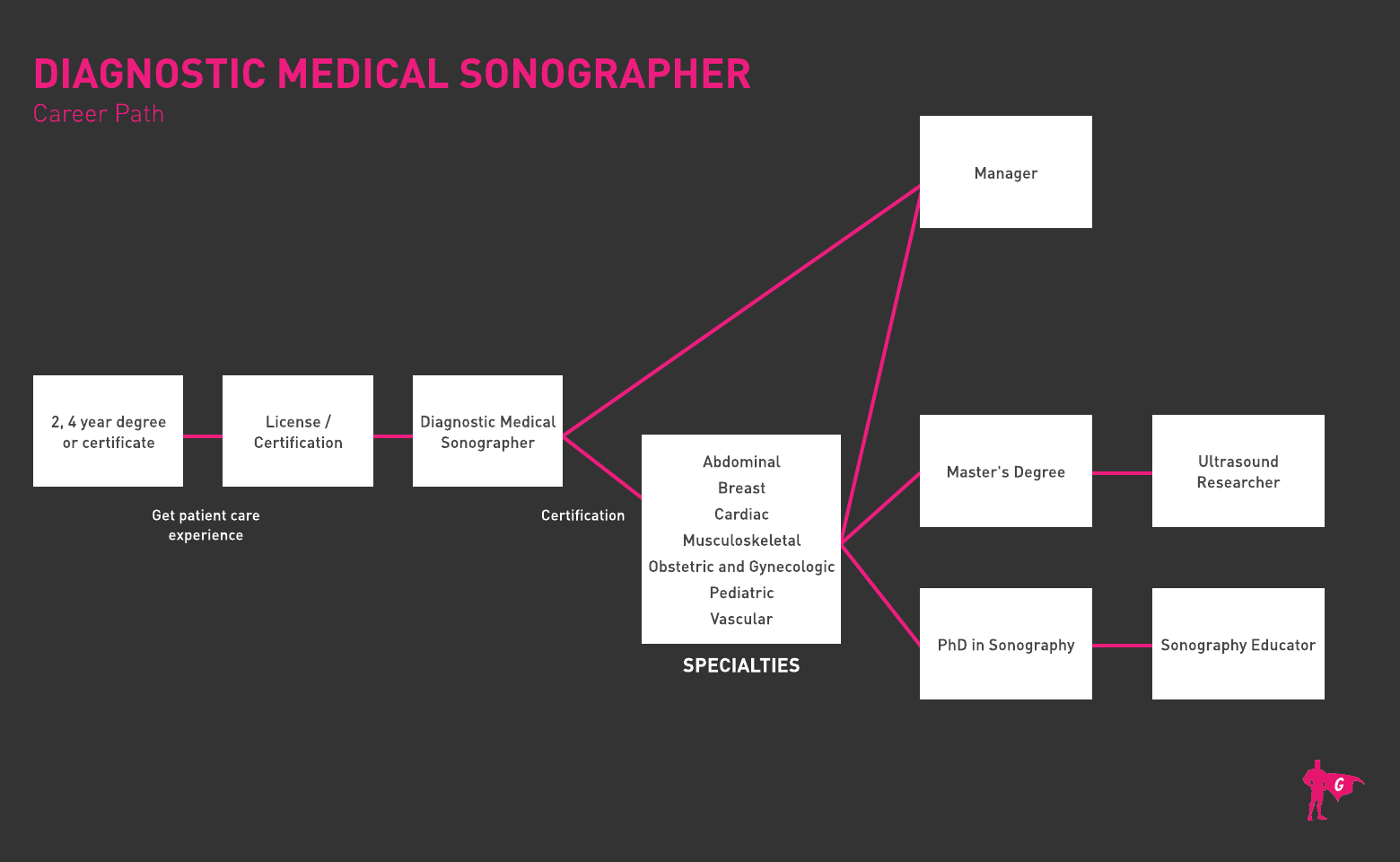
Most Diagnostic Medical Sonographers complete a formal program in sonography that combines classroom study with extensive hands-on clinical training. Programs are offered as certificates, associate degrees, and bachelor's degrees. Certificate programs, which can take about a year, are often designed for people who already have a degree or experience in another healthcare field, such as nursing or radiologic technology. Associate degree programs, typically about two years, are the most common entry point for students coming straight from high school, and bachelor's programs, typically four years, add more science and leadership content that can lead to management, education, and research roles. Employers and certifying bodies strongly prefer graduates of programs accredited by the Commission on Accreditation of Allied Health Education Programs (CAAHEP), which recognizes sonography programs on the recommendation of the Joint Review Committee on Education in Diagnostic Medical Sonography (JRC-DMS).
Credentials matter a great deal in this field. The most widely recognized come from the American Registry for Diagnostic Medical Sonography (ARDMS). To earn a credential such as Registered Diagnostic Medical Sonographer (RDMS), Registered Diagnostic Cardiac Sonographer (RDCS), Registered Vascular Technologist (RVT), or Registered Musculoskeletal Sonographer (RMSKS), you must pass the Sonography Principles and Instrumentation (SPI) physics exam plus at least one specialty exam, such as abdomen, breast, obstetrics and gynecology, pediatric sonography, adult echocardiography, or vascular technology, within five years of each other, after meeting ARDMS education and clinical prerequisites. Graduating from an accredited program is the most direct way to meet those prerequisites. Cardiovascular Credentialing International (CCI) offers cardiac and vascular credentials, including the Registered Cardiac Sonographer (RCS) and Registered Vascular Specialist (RVS), and the American Registry of Radiologic Technologists (ARRT) offers sonography and breast sonography credentials for radiologic technologists who want to cross over. Most credentials must be maintained through continuing education.
Most states do not require a special state license to work as a sonographer, but a small number of states, such as Oregon, New Mexico, North Dakota, and New Hampshire, have licensing rules, and requirements can change. Employers nearly everywhere expect a national credential and current CPR or basic life support certification. Always check your state's rules and the requirements of your employer before you choose a program.
Students can take courses in relevant subjects such as:
- Introduction to Sonography and Patient Care
- Human Anatomy and Physiology
- Medical Terminology
- Ultrasound Physics and Instrumentation
- Abdominal and Small Parts Scanning and Pathology
- Obstetrics and Gynecology Scanning and Pathology
- Vascular Scanning and Physiology
- Echocardiography Principles
- Cross-Sectional Anatomy
- Clinical Practice or Clinical Education Rotations
Clinical training is a major part of every program. Students spend many hours in hospitals and clinics scanning real patients under the supervision of experienced sonographers, building up the number of exams and the skill needed to work independently. This is where you will learn patient communication, ergonomics, and how to adapt when a patient has a larger body size, is in pain, or cannot hold still. It is also where you meet future coworkers, and many students are hired by the sites where they trained.
Learning continues throughout your career. Many sonographers add a second or third credential, such as echocardiography after general sonography, take continuing education to keep their registry active, and go back to school for a bachelor's or advanced degree if they are interested in leadership, research, or teaching.
- Take biology, anatomy and physiology, chemistry, physics, algebra, and English in high school, because sonography is built on science and communication
- Shadow a working sonographer, or ask for an informational interview, to see what the day is like and to learn about different specialties
- Join a health science program, a HOSA chapter, or a career and technical education pathway in healthcare
- Volunteer in a hospital, clinic, or nursing home to practice patient care, build your resume, and see how teams work
- Earn your CPR or basic life support certification and keep it current, since most programs and employers require it
- Take medical terminology, anatomy, and physics courses in high school or through dual enrollment if they are offered
- Research sonography programs early, because many have limited seats, prerequisites, and application deadlines, and compare certificate, associate, and bachelor's paths
- Watch videos and read about different specialties, such as obstetrics, echocardiography, and vascular sonography, to see which one excites you
- Pay attention to your body and learn good posture and stretching habits now, since ergonomics matters throughout this career
- Practice staying calm and friendly with people of all ages, whether in a job, volunteer role, or team activity
- Follow professional organizations such as the Society of Diagnostic Medical Sonography and the American Institute of Ultrasound in Medicine to learn the language of the field
- Remember that you can start with a certificate or associate degree and return later for a bachelor's, so choose a path that fits your life and goals today
- Programmatic accreditation from CAAHEP, which supports eligibility for ARDMS and other credentials
- Strong first-time pass rates on the ARDMS SPI and specialty exams, and solid job placement rates
- Clinical sites with a variety of patients and exam types, so you graduate ready for more than one setting
- Enough hands-on scanning time, with supportive clinical instructors who give honest feedback
- Modern ultrasound machines and a lab where you can practice scanning before you work with patients
- A clear plan for how clinical placements are assigned, how many hours are required, and whether the school helps find sites
- Training in more than one specialty, or a clear path to add one later
- Instruction in ergonomics and safe scanning techniques
- Support in preparing for credentialing exams, including physics review
- Honest information on program length, costs, and prerequisites, including any science courses needed before you apply
- Career services that help with resumes, interviews, and job leads
- A pathway from a certificate or associate degree to a bachelor's if you may want to teach, manage, or do research later
- Earn your basic life support (CPR) certification before you start looking, since many employers expect it
- Pass the SPI exam and at least one specialty exam as soon as you are eligible, because credentialed sonographers are generally the most employable, and those with more than one credential are even more so
- Treat clinical rotations as your best networking chance. Show up early, ask good questions, accept feedback, and ask supervisors about openings, because many students are hired by their clinical sites
- Consider starting with a one-year certificate if you already have a healthcare degree, or an associate degree if you want to get working sooner. Many sonographers add a bachelor's later while working
- Search for jobs on hospital career pages, health system websites, and sites such as Indeed, Glassdoor, and Simply Hired, and set up alerts using titles such as Sonographer, Ultrasound Technologist, Echo Technologist, and Vascular Technologist
- Be open to location, since most jobs are in hospitals, and areas with many hospitals and imaging centers offer more openings. Travel or per diem work can also be a way in
- Think about where demand is growing, such as cardiac and vascular imaging for aging populations, and consider adding those specialties
- Ask your school's career center or program director to help with resumes, mock interviews, and job leads
- Prepare a resume that lists your scanning experience, the number and types of exams you performed, your credentials, and your CPR certification, and have a trusted person proofread it
- Practice common interview questions, such as how you would handle a nervous patient, a difficult scan, or a heavy workload, and dress professionally
- Line up references early, such as clinical instructors, professors, and supervisors who have seen you work with patients
- Join a professional organization as a student to learn about the field, find mentors, and hear about job openings
- Be a model employee by showing up on time, being kind to patients, producing high-quality images, and accepting feedback
- Earn additional credentials, such as adult echocardiography, vascular technology, breast, or pediatric sonography, which can lead to higher-level roles and wider job choices
- Take opportunities when they appear, such as training new hires, leading a quality project, or learning a new type of exam, and speak up when you are ready for a promotion
- Move into roles such as lead sonographer, chief sonographer, or ultrasound department manager by building leadership and communication skills, and consider a bachelor's degree
- Explore roles outside the exam room, such as clinical applications specialist for an equipment company, clinical instructor, or program director
- Pursue a bachelor's or master's degree if you want to become a sonography educator, and take courses in teaching and curriculum design
- Join research projects, contribute to studies, and build expertise in an area such as maternal-fetal medicine, cardiac imaging, or ultrasound technology if you want to work with researchers
- Protect your body and your career by practicing good ergonomics, staying fit, and speaking up early if pain starts
Websites:
- American Registry for Diagnostic Medical Sonography (ARDMS), part of Inteleos - inteleos.org
- Society of Diagnostic Medical Sonography (SDMS) - sdms.org
- American Institute of Ultrasound in Medicine (AIUM) - aium.org
- Commission on Accreditation of Allied Health Education Programs (CAAHEP) - caahep.org
- Joint Review Committee on Education in Diagnostic Medical Sonography (JRC-DMS) - jrcdms.org
- Cardiovascular Credentialing International (CCI) - cci-online.org
- American Society of Echocardiography (ASE) - asecho.org
- Society for Vascular Ultrasound (SVU) - svu.org
- American Registry of Radiologic Technologists (ARRT) - arrt.org
- American Society of Radiologic Technologists (ASRT) - asrt.org
- Alliance of Cardiovascular Professionals - acp-online.org
- International Society of Ultrasound in Obstetrics and Gynecology (ISUOG) - isuog.org
- Intersocietal Accreditation Commission (IAC) - intersocietal.org
- HOSA - Future Health Professionals - hosa.org
Books:
- Textbook of Diagnostic Sonography by Sandra L. Hagen-Ansert
- Diagnostic Medical Sonography: Obstetrics and Gynecology by Susan Raatz Stephenson and Julia Dmitrieva
- Diagnostic Medical Sonography: The Vascular System by Ann Marie Kupinski
- Sonography: Introduction to Normal Structure and Function by Reva Curry and Marilyn Prince
If you find that being a Diagnostic Medical Sonographer isn't the right fit, your interest in healthcare, technology, and hands-on patient care can lead to many other rewarding careers.
- Radiologic Technologist
- Cardiovascular Technologist
- MRI Technologist
- Nuclear Medicine Technologist
- Radiation Therapist
- Respiratory Therapist
- Registered Nurse
- Surgical Technologist
- Clinical Applications Specialist for Imaging Equipment
- Physician Assistant
Newsfeed

Featured Jobs
Online Courses and Tools
Annual Salary Expectations
New workers start around $116K. Median pay is $142K per year. Highly experienced workers can earn around $173K.