






Spotlights
Healthcare Administrator, Healthcare Executive, Hospital Administrator, Health Services Manager, Medical Practice Manager, Clinic Manager, Nursing Home Administrator, Department Director, Health Information Management Director, Patient Care Services Director, Practice Administrator, Healthcare Operations Manager
When you visit a doctor, there is a whole world behind the exam room door that you rarely notice. Someone made sure the clinic had enough nurses on the schedule, the supplies were ordered, the insurance paperwork made sense, the computer systems worked, and the building met every safety rule. Someone also decided how to use a limited budget to open a new emergency room, add evening hours, or keep a community clinic running. That someone is often a Health Service Manager, a leader who makes it possible for doctors, nurses, and technicians to do their best work and for patients to get the care they need.
Health Service Managers, also called healthcare administrators or executives, plan, direct, and coordinate medical and health services. Some run an entire hospital, nursing home, or health system. Others manage a department, such as nursing, radiology, billing, or medical records, or a physician group practice or clinic. They hire and guide staff, set goals, create schedules, prepare and track budgets, make sure the organization follows healthcare laws and standards, and solve problems that cross departments. They also listen to patients and employees, work with doctors and board members, and represent the organization to the community, insurers, regulators, and government agencies. In small organizations, one manager may do everything. In large ones, they specialize in areas like finance, operations, quality, or human resources.
To do this work, Health Service Managers use finance tools, data dashboards, electronic health record systems, scheduling software, and project management methods to see what is working and what is not. They need to understand healthcare regulations, privacy rules, and how services are paid for. Their work matters because healthcare is complicated, expensive, and personal, and a well-run organization can mean shorter waits, safer care, happier staff, and care that stays available in a community. If you like leading teams, solving puzzles with people and numbers, and making big systems work better for others, this career offers a way to help many people at once.
- Making a difference for whole communities by helping hospitals, clinics, and care teams run smoothly and serve patients well
- Leading people and projects, and seeing your decisions improve safety, access, and patient experience
- Choosing from a wide range of settings, from rural clinics to big hospital systems to public health agencies, and moving between them as your interests grow
- Having strong opportunities to advance, from department manager to senior executive, and to specialize in areas such as finance, technology, quality, or long-term care
Working Schedule
Most Health Service Managers work full-time, and many work more than 40 hours a week. In clinics and offices, the schedule may follow regular business hours, but managers often attend early meetings, evening community events, and occasional weekend projects. In hospitals and nursing homes, which run around the clock, managers may be on call, respond to emergencies at odd hours, and rotate through administrator-on-call duties. Most of the work happens in offices, meeting rooms, and on the floors of the facility, since good managers walk the halls, visit departments, and talk with staff. Travel can include conferences, trips to satellite clinics, visits with partners, and meetings with regulators or leaders. In small organizations, managers may handle many roles, while in large systems they typically focus on one department or function.
Typical Duties
- Setting goals and priorities for a facility, department, or practice and creating plans to meet them
- Preparing, monitoring, and explaining budgets, and making sure spending stays within available funding
- Overseeing billing, patient fees, and payment processes, and working with insurance companies and government programs
- Recruiting, hiring, training, scheduling, and evaluating staff, and handling performance and conflict issues
- Making sure the organization follows healthcare laws, accreditation standards, privacy rules, and safety regulations
- Keeping records of services, such as patient volume and bed use, and using data to guide decisions
- Leading projects to improve quality, patient safety, and patient experience
- Working with doctors, nurses, and department heads to understand their needs and solve problems
- Preparing reports and presentations for executives, boards, and investors
- Representing the organization at meetings, community events, and with outside partners
- Managing contracts with vendors, suppliers, and other healthcare organizations
- Planning new services, programs, or buildings, and adapting plans when needs change
Additional Responsibilities
- Overseeing technology projects, such as new electronic health record systems and cybersecurity upgrades
- Preparing the organization for inspections, audits, and accreditation reviews
- Leading emergency preparedness and response planning
- Supporting diversity, equity, and community health efforts
- Negotiating with insurers, suppliers, and physician groups
- Mentoring emerging leaders and supporting professional development for staff
- Responding to complaints and communicating with patients and families
- Joining professional organizations and staying current on healthcare policy and law
A Health Service Manager's morning often starts with a look at the day's numbers and messages. At a hospital, that might mean checking how many patients came in overnight, how many beds are open, whether the staffing schedule is covered, and whether any safety issues were reported. At a clinic, it might mean reviewing the day's appointments, making sure the front desk and exam rooms are staffed, and following up on a billing issue. Then comes a series of meetings. A manager might meet with department leaders to talk about a nursing shortage, review a budget report with finance, or work with the IT team on a new scheduling system.
Midday often brings people problems and practical decisions. A department head may need help resolving a conflict between team members. A physician may ask for new equipment, and the manager has to weigh the cost, the evidence, and the needs of other departments. Another meeting may focus on a new regulation, a patient complaint, or a plan to shorten waiting times in the emergency department. The manager may spend time walking through units, greeting staff, and noticing what is working and what is not, because those visits often reveal problems that reports miss.
Afternoons might include interviews with job candidates, a call with an insurance partner, and time for planning. A manager may work on a presentation for the board, analyze data to find out why surgery start times are slipping, or write a plan to open a new clinic in an underserved neighborhood. Late in the day, they respond to emails, approve schedules and purchases, and check in with leaders about any urgent problems. Some days are calm and strategic, and others are filled with surprises, but a good manager keeps the bigger picture in mind and stays steady for the team.
Soft Skills
- Leadership and the ability to motivate and guide diverse teams
- Clear written and spoken communication, including explaining complex issues to different audiences
- Critical thinking and analytical skills to solve problems using facts, people, and numbers
- Decision making under pressure, often with incomplete information
- Interpersonal skills and empathy for patients, staff, and families
- Conflict resolution and negotiation
- Organization and time management in a job with many priorities
- Integrity and ethical judgment, especially when making hard decisions about budgets, staffing, and care
- Adaptability and resilience in a field that changes quickly
- Collaboration with physicians, nurses, technicians, and community partners
- Cultural awareness and the ability to build trust in diverse communities
- Diplomacy and the ability to make decisions that balance the needs of patients, staff, and the organization
Technical Skills
- Budgeting, financial analysis, and understanding of how healthcare is paid for, including insurance and government programs
- Knowledge of healthcare laws and regulations, such as privacy rules and accreditation standards
- Human resources skills, including hiring, scheduling, and performance management
- Project management and process improvement methods, such as Lean and quality improvement
- Use of electronic health record systems and healthcare information systems
- Data analysis and reporting, including spreadsheets, dashboards, and basic database tools
- Understanding of billing, coding, and the revenue cycle
- Strategic planning and marketing for healthcare services
- Knowledge of patient safety, risk management, and infection control basics
- Awareness of healthcare technology, cybersecurity, and artificial intelligence tools
- Hospital Administrator or Executive: Leads a hospital or health system, sets strategy, and oversees operations, finance, and quality
- Department Manager or Director: Runs a specific area, such as nursing services, radiology, surgery, the laboratory, or patient access
- Practice or Clinic Manager: Manages the business and daily operations of a physician group, specialty practice, or community clinic
- Nursing Home or Long-Term Care Administrator: Leads a skilled nursing facility or similar community, and must be licensed in every state
- Assisted Living Administrator: Manages residential care communities for older adults, often with state licensing requirements that vary
- Health Information Manager: Oversees medical records, data quality, privacy, and information systems
- Public Health or Community Health Program Manager: Leads programs for health departments, nonprofits, and community health centers
- Quality, Compliance, or Patient Safety Manager: Focuses on improving care, meeting standards, and reducing risk
- Community hospitals and large hospital systems
- Academic medical centers and teaching hospitals
- Physician group practices and specialty clinics
- Community health centers and free clinics
- Nursing homes, assisted living communities, and rehabilitation facilities
- Home health and hospice agencies
- Outpatient surgery and imaging centers
- Behavioral and mental health organizations
- Managed care organizations and health insurance companies
- Public health departments and government agencies
- Veterans Affairs hospitals and military health systems
- Consulting firms, health technology companies, and nonprofit organizations
Health Service Management comes with big responsibility and long hours. You may start your day early, stay late for meetings, and be called at night or on weekends when a problem arises. Managers in hospitals and nursing homes often take turns being the leader on call for emergencies. The job requires making tough choices about budgets, staffing, and priorities, and no choice makes everyone happy. You may have to deliver hard news, handle conflict, or manage complaints. Because your decisions affect patient care, staff jobs, and community access, the pressure can be real.
Education and experience take time. Most managers have at least a bachelor's degree, and many go on to earn a master's degree to reach senior roles. In many organizations, you will start in an entry-level or supervisory role, or in a post-graduate administrative fellowship, and work your way up over years. If you want to run a nursing home, you also need a state license, which includes supervised training and passing exams. Managers must keep learning about changing laws, new technology, payment models, and leadership methods, and they often keep earning certifications or attend conferences throughout their careers.
At the same time, the job can be highly rewarding for those who like leading and solving complex problems. Health Service Managers rarely work directly at the bedside, so people who love hands-on patient care sometimes miss it, though many stay close to patients by walking the units, meeting families, and working side by side with frontline staff. Those who thrive tend to be calm, curious, honest, and good listeners. They enjoy the challenge of balancing mission and money, and they take pride in helping an entire organization succeed in caring for others.
- Growth of value-based care, which rewards quality and outcomes instead of the number of services provided
- Rapid expansion of telehealth, remote monitoring, and digital tools that change how and where care is delivered
- Use of artificial intelligence and automation for scheduling, billing, documentation, and predicting patient needs, with leaders overseeing safety, privacy, and fairness
- Shift of care from hospitals to outpatient centers, urgent care, and home-based services
- Increased pressure to control costs while maintaining quality, including supply chain and workforce costs
- Workforce shortages and burnout, which make recruiting, retention, and staff well-being top priorities for leaders
- Greater focus on health equity, community health needs, and reaching underserved populations
- Mergers and partnerships among hospitals, health systems, and physician groups
- Rising importance of data privacy and cybersecurity as healthcare systems become frequent targets for attacks
- Stronger emphasis on patient experience, price transparency, and clear communication with patients
Many Health Service Managers were natural organizers and leaders as kids. They ran for student council, led clubs, captained teams, or became the one who planned the group project, the fundraiser, or the school dance. They liked taking charge when a plan needed to come together and were often good at noticing what needed to be done and getting others on board. They enjoyed puzzles, strategy games, and building things, and many were curious about how businesses and systems work.
Many also had a strong interest in helping people and healthcare. They might have volunteered at a hospital, cared for a family member, or spent time in a clinic and wondered who made everything work behind the scenes. Some had parents or relatives in healthcare, or became curious after experiencing a health challenge, and they wanted to help improve the system for others. They were often good communicators who could listen, explain, and bring people together.
Most Health Service Managers have at least a bachelor's degree, and many hold a master's degree, especially for senior roles in hospitals and health systems. Common undergraduate majors include health administration, health services management, business administration, nursing, public health, and health information management. Typical courses include accounting, health economics, health information systems, human resources, health law and ethics, and management. For undergraduate degrees, some students choose programs that are certified or recognized by the Association of University Programs in Health Administration (AUPHA), which supports programs in health administration and often includes an internship in a healthcare setting.
For many leadership roles, a graduate degree opens more doors. Common choices include the Master of Health Administration (MHA), the Master of Business Administration (MBA) with a healthcare focus, the Master of Public Health (MPH) with a management or policy focus, and dual degrees that combine them. The Commission on Accreditation of Healthcare Management Education (CAHME) accredits healthcare management education programs, and the Council on Education for Public Health (CEPH) accredits public health programs. After graduate school, many people complete a post-graduate administrative fellowship, usually one to two years in a hospital or health system, which combines rotations, projects, and mentorship and often leads to a leadership job. Some managers also advance without a graduate degree by working their way up through clinical or administrative roles, though a graduate degree tends to open more opportunities as you advance.
Licensure and certification depend on the setting. Nursing home administrators must be licensed in every state, and licensing typically requires a bachelor's degree in most states, a period of supervised training sometimes called an administrator-in-training or residency program, and passing a national exam from the National Association of Long Term Care Administrator Boards (NAB) plus a state exam in many states. Assisted living administrators are licensed or certified in many states, with rules that vary widely. Some roles prefer or require a nursing, social work, or other clinical license. Voluntary credentials can help you stand out, such as board certification in healthcare management through the American College of Healthcare Executives (ACHE), which leads to the Fellow (FACHE) designation after you meet experience, education, and exam requirements, the Registered Health Information Administrator (RHIA) credential from the American Health Information Management Association (AHIMA), and the Certified Medical Practice Executive (CMPE) credential for practice managers through the Medical Group Management Association (MGMA). Always check requirements in the state and for the role you want.
Students can take courses in relevant subjects such as:
- Principles of Management and Leadership
- Financial and Managerial Accounting
- Health Economics and Health Policy
- Healthcare Finance and Budgeting
- Human Resources Management
- Health Law, Ethics, and Compliance
- Health Information Systems and Data Analytics
- Quality Improvement and Patient Safety
- Medical Terminology and the U.S. Healthcare System
- Statistics and Communication
Hands-on experience is a big part of preparing for this career. Internships, volunteer work, part-time jobs in hospitals and clinics, and student leadership roles all show employers that you understand how healthcare works and can lead. Many managers start in clinical roles, medical records, billing, scheduling, or administrative support, and move up as they gain experience and education. Classes teach concepts, but real learning happens when you work with a team and solve real problems.
Learning continues throughout your career. Healthcare laws, technology, and payment models change quickly, so managers keep growing through conferences, certifications, mentors, and professional organizations.
- Take challenging classes in math, accounting, business, English, communications, and biology, which build the skills you will use in healthcare management
- Join clubs, student government, debate, or health science programs to practice leadership, public speaking, and teamwork
- Volunteer at a hospital, clinic, nursing home, or community health organization to see how healthcare organizations work
- Look for a part-time or summer job in a healthcare setting, even in a front desk, records, or support role, to learn how the business side works
- Ask a healthcare manager for an informational interview or job shadow to learn what their days are like
- Take on project-based roles where you plan events, manage budgets, or lead teams, since those experiences translate directly to management
- Learn about spreadsheets, data tools, and presentation software, and explore basic coding or data analysis if you can
- Study a foreign language or learn about other cultures, which helps you serve diverse communities
- In college, choose a major such as health administration, business, nursing, or public health, and look for programs with internships and strong ties to local healthcare employers
- Join a student chapter of a healthcare management organization and attend events to meet professionals
- Find a mentor who can offer advice about courses, internships, and careers
- Keep a running resume of your jobs, leadership roles, projects, and achievements, and update it often so that you do not forget anything
- For undergraduate study, a program in health administration or health management that is AUPHA-certified and includes a required internship in a healthcare setting
- For graduate study, programs accredited by CAHME for healthcare management degrees, or by CEPH for public health degrees
- Strong connections to local hospitals, health systems, and clinics for internships, residencies, and fellowships
- Faculty who have worked as healthcare leaders and who mentor students
- A curriculum that covers finance, operations, policy, law, information systems, and leadership
- Opportunities to learn data analytics, quality improvement, and healthcare technology
- An active alumni network and a record of placing graduates in administrative fellowships and leadership roles
- For nursing home administration, a program that helps you meet your state's education and training requirements
- Practical experiences such as case competitions, consulting projects, and simulations
- Flexible options, such as part-time, evening, or online formats, if you plan to work while studying
- Reasonable costs, financial aid, and scholarships from professional organizations
- Career services that help with resumes, interviews, and finding fellowships and first jobs
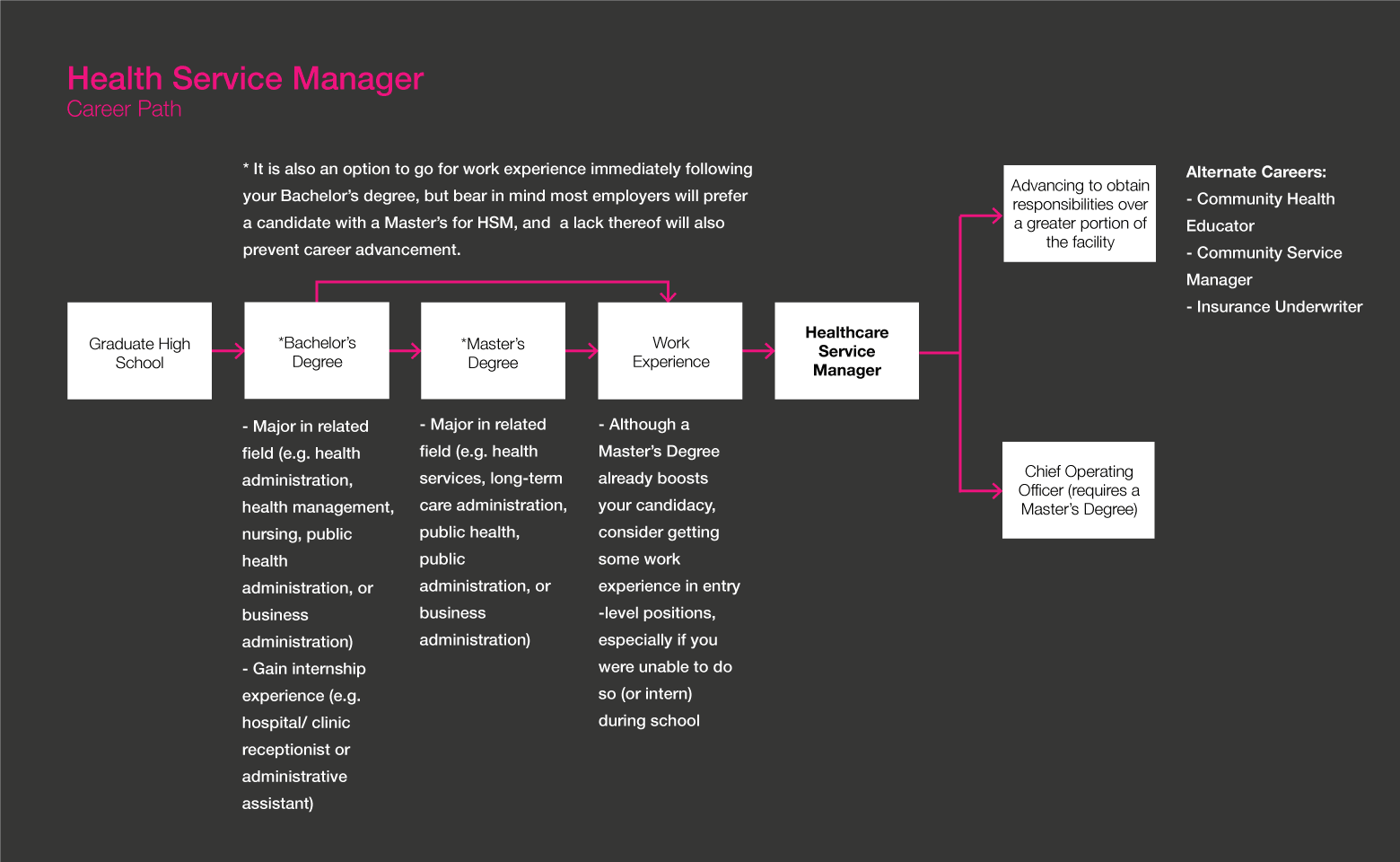
- Complete internships during school, ideally at a hospital or health system. Many employers hire students who have already shown they can do the work
- Consider a bachelor's degree from an AUPHA-certified program, or a graduate degree from a CAHME-accredited program, which employers know and trust
- Apply for post-graduate administrative fellowships, which many hospitals and health systems offer to recent master's graduates, and start the search early because competition is strong
- Start in roles that build your knowledge, such as project coordinator, administrative assistant, patient access representative, billing or records specialist, or supervisor, and then move into management
- Build healthcare information technology and data skills, since employers value managers who can use data and manage systems
- Join a professional organization such as ACHE (which has student associate membership) as a student, attend events, and use the job boards to find openings and make connections
- Network with professors, alumni, preceptors, and healthcare leaders, and ask for informational interviews
- Apply to different types of organizations, such as hospitals, clinics, nursing homes, public health agencies, and physician practices, because each offers different entry points
- If you want to run a nursing home, plan for your state's licensing path, including the administrator-in-training program and exams
- Tailor your resume to show leadership roles, projects, budgets managed, and results, using numbers when you can
- Prepare for interviews by learning about the organization's mission, size, and challenges, and be ready to talk about teamwork, ethics, and problem solving
- Show confidence and experience in making firm decisions, and show diplomacy in the way you explain them
- Build a track record of reliable results, such as improving a process, meeting a budget, or leading a successful project
- Earn a graduate degree such as an MHA, MBA, or MPH if you do not already have one, or pursue a doctorate if you are interested in teaching and research
- Pursue board certification and the Fellow designation through ACHE, and consider other credentials in areas like health information, finance, or practice management
- Seek stretch assignments, committee roles, and cross-department projects that expose you to different parts of the organization
- Find mentors and sponsors who can guide you and advocate for you, and mentor others as you grow
- Develop strong communication and diplomacy skills so you can navigate competing interests and lead teams effectively
- Specialize in an area of high need, such as finance, quality and safety, population health, informatics, or long-term care
- Stay active in professional organizations, attend conferences, and follow healthcare news and policy
Websites:
- American College of Healthcare Executives (ACHE) - ache.org
- Association of University Programs in Health Administration (AUPHA) - www.aupha.org
- Commission on Accreditation of Healthcare Management Education (CAHME) - cahme.org
- American Hospital Association (AHA) - aha.org
- Healthcare Financial Management Association (HFMA) - hfma.org
- Medical Group Management Association (MGMA) - mgma.com
- American Health Information Management Association (AHIMA) - ahima.org
- Healthcare Information and Management Systems Society (HIMSS) - himss.org
- National Association of Long Term Care Administrator Boards (NAB) - nabweb.org
- LeadingAge - leadingage.org
- Institute for Healthcare Improvement (IHI) - ihi.org
- National Center for Healthcare Leadership (NCHL) - nchl.org
- Council on Education for Public Health (CEPH) - ceph.org
Books:
- Shortell & Kaluzny's Health Care Management: Organization Design and Behavior by Lawton Robert Burns, Elizabeth H. Bradley, and Bryan J. Weiner
- Introduction to Health Care Management by Sharon B. Buchbinder, Nancy H. Shanks, and Rachel Rogers
- 101 Careers in Healthcare Management by Leonard H. Friedman and Anthony R. Kovner
- Lean Hospitals: Improving Quality, Patient Safety, and Employee Engagement by Mark Graban
- An American Sickness: How Healthcare Became Big Business and How You Can Take It Back by Elisabeth Rosenthal
If you find that being a Health Service Manager isn't the right fit, your interest in healthcare, leadership, and organizing people and systems can lead to many other rewarding careers.
- Community Health Educator
- Community Service Manager
- Health Information Technician or Manager
- Medical and Health Informatics Specialist
- Healthcare Consultant
- Human Resources Specialist
- Public Health Program Coordinator
- Insurance Underwriter
- Medical Office Manager
- Health Policy Analyst
Newsfeed

Featured Jobs
Online Courses and Tools
Annual Salary Expectations
New workers start around $104K. Median pay is $160K per year. Highly experienced workers can earn around $210K.