






Spotlights
Optometric Assistant, Optician Assistant, Ophthalmic Assistant, Eyewear Consultant, Optical Technician, Dispensing Assistant, Optical Sales Associate, Vision Care Assistant, Eyewear Specialist, Optical Support Staff, Optical Receptionist, Lens Fitting Assistant
When you walk into an optical shop, the first friendly face you might meet is an Optical Assistant, whose expert help guides you to the perfect pair of glasses or contact lenses. Their work shapes how people see the world by ensuring their eyewear fits comfortably, looks great, and suits their vision needs.
Optical Assistants work closely with optometrists, opticians, and customers to provide hands-on support throughout the eyewear selection and preparation process. They greet customers, help choose frames, measure and adjust fittings, place orders for lenses, and sometimes perform initial eye screenings before an exam. Their goal is to make each customer’s experience smooth, personalized, and confident.
Using specialized tools like frame measurement devices, vision testing equipment, and computer systems to manage orders and appointments, Optical Assistants play a vital role in the healthcare journey. Their combination of technical skill, fashion sense, and customer service ensures that every pair of glasses not only improves vision but also boosts confidence and comfort.
- Helping people find the perfect glasses that improve their vision and style.
- Building strong relationships with customers through personalized service.
- Learning about eye health and optical technology while assisting professionals.
- Seeing the positive impact of your work when customers leave happy and satisfied.
Working Schedule
Optical Assistants typically work in retail optical shops, eye clinics, or healthcare centers, usually during regular business hours Monday through Saturday. While most shifts are daytime, some locations may require evening or weekend hours. The environment is customer-facing and fast-paced, with a mix of standing, walking, and sitting. Many Optical Assistants are employed full-time, but part-time or flexible schedules are also common depending on the employer.
Typical Duties
- Welcoming customers as they enter the optical shop with a friendly attitude.
- Helping customers select frames that complement their face shape and prescription needs.
- Measuring customers’ facial features and frames to ensure a comfortable fit.
- Assisting in ordering prescription lenses and contact lenses based on customer requirements.
- Scheduling follow-up appointments and managing customer records.
- Adjusting and repairing frames when customers pick up their glasses.
- Conducting preliminary vision screenings such as retinal imaging and pressure tests when trained.
- Explaining product options, special offers, and warranty details to customers.
- Answering customer questions about eyewear care and insurance coverage.
- Handling transactions and processing payments.
- Maintaining the cleanliness and organization of display areas and workstations.
- Coordinating with optometrists and lab technicians to ensure timely delivery of eyewear.
Additional Responsibilities
- Keeping up-to-date with new eyewear styles and lens technologies.
- Assisting with inventory management and restocking frames and accessories.
- Supporting marketing efforts by setting up displays and informing customers about promotions.
- Helping train new Optical Assistants or interns when applicable.
- Maintaining confidentiality of customer health information.
- Ensuring compliance with health and safety regulations in the optical shop.
- Contributing to customer feedback and service improvement initiatives.
Morning starts with preparing the optical shop for customers by organizing displays and checking appointments for the day. Optical Assistants review any special orders or tasks from the previous day and make sure all equipment is ready for use.
Midday involves greeting customers, assisting with frame selection by combining fashion advice with prescription needs, measuring and fitting frames, and sometimes performing pre-examination screenings. They coordinate with optometrists and lab staff to track orders and address customer questions.
Afternoon and evening focus on finalizing eyewear adjustments as customers pick up their glasses, processing payments, scheduling follow-ups, and tidying the workspace. Optical Assistants often communicate with suppliers and keep up with new product information to provide excellent customer service. They also document customer interactions and prepare for the next day.
Soft Skills
- Friendly and approachable demeanor
- Strong communication and listening skills
- Patience and tact when dealing with customer concerns
- Attention to detail for precise measurements and adjustments
- Ability to work well in a team
- Organizational skills for managing appointments and inventory
- Adaptability to learn new technologies and products
- Problem-solving skills to handle fitting issues
- Sales skills to suggest suitable products
- Empathy to understand customer needs
- Confidence in explaining technical information simply
- Positive attitude and energy throughout the workday
Technical Skills
- Proficiency in measuring facial features and frame dimensions
- Basic understanding of lens types and prescriptions
- Use of vision screening tools like retinal cameras and tonometers
- Familiarity with optical equipment for frame adjustments
- Computer skills for managing customer records and orders
- Knowledge of eyewear materials and fitting techniques
- Ability to handle payment processing systems
- Understanding health and safety regulations in optical settings
- Skill in repairing and adjusting frames
- Awareness of product warranties and insurance processes
- Retail Optical Assistant: Works in eyewear stores helping customers select and fit glasses.
- Clinical Optical Assistant: Supports optometrists in eye clinics and may perform preliminary vision tests.
- Contact Lens Assistant: Specializes in fitting and instructing customers on contact lens use.
- Dispensing Assistant: Focuses on preparing and adjusting ordered eyewear for customers.
- Sales Optical Assistant: Combines customer service with sales goals in busy retail environments.
- Optical Receptionist: Manages appointments and customer flow in optical practices.
- Mobile Optical Assistant: Travels to different locations to provide eyewear services and screenings.
- Optical Lab Assistant: Works behind the scenes preparing lenses and assembling frames.
- Independent optical retail stores
- Large eyewear chains and franchises
- Ophthalmology clinics and eye care centers
- Hospitals with eye care departments
- University health services
- Mobile vision screening services
- Optical laboratories
- Online eyewear retailers with physical locations
- Community health clinics
- Vision insurance providers with retail outlets
- Corporate eyewear providers
- Military or government health services
The role can be fast-paced and customer-focused, requiring patience and the ability to manage multiple tasks at once. Optical Assistants often face pressure to meet sales goals while maintaining excellent service.
Work hours generally follow normal business days, but weekend and holiday shifts are common in retail settings. Standing for extended periods and repetitive tasks like frame adjustments are typical physical demands.
Attention to detail is critical because even small errors in measurements or orders can impact vision quality. Optical Assistants must be willing to continually learn about new products and technologies to keep up with industry changes.
- Increasing use of digital measurements and 3D scanning for precise frame fitting.
- Growth in online eyewear sales influencing how assistants interact with customers.
- More advanced pre-screening technology allowing assistants to perform expanded roles.
- Rising demand for fashionable and customizable eyewear options.
- Integration of electronic health records in optical practices.
- Greater emphasis on sustainable and eco-friendly eyewear materials.
- Use of virtual try-on technology in stores.
- Expansion of contact lens fitting and care services.
- Enhanced customer service training focused on personalized experiences.
- Growth of tele-optometry services affecting assistant roles.
Many Optical Assistants discovered their interest early through caring for family members’ vision needs or experimenting with fashion and design related to eyewear. A natural curiosity about how vision works and a desire to help others see better often spark interest.
Kids who enjoy hands-on activities like fixing things, organizing, and working with technology may find this career a great fit. They often have strong people skills and enjoy communicating clearly, making them comfortable in customer service roles.
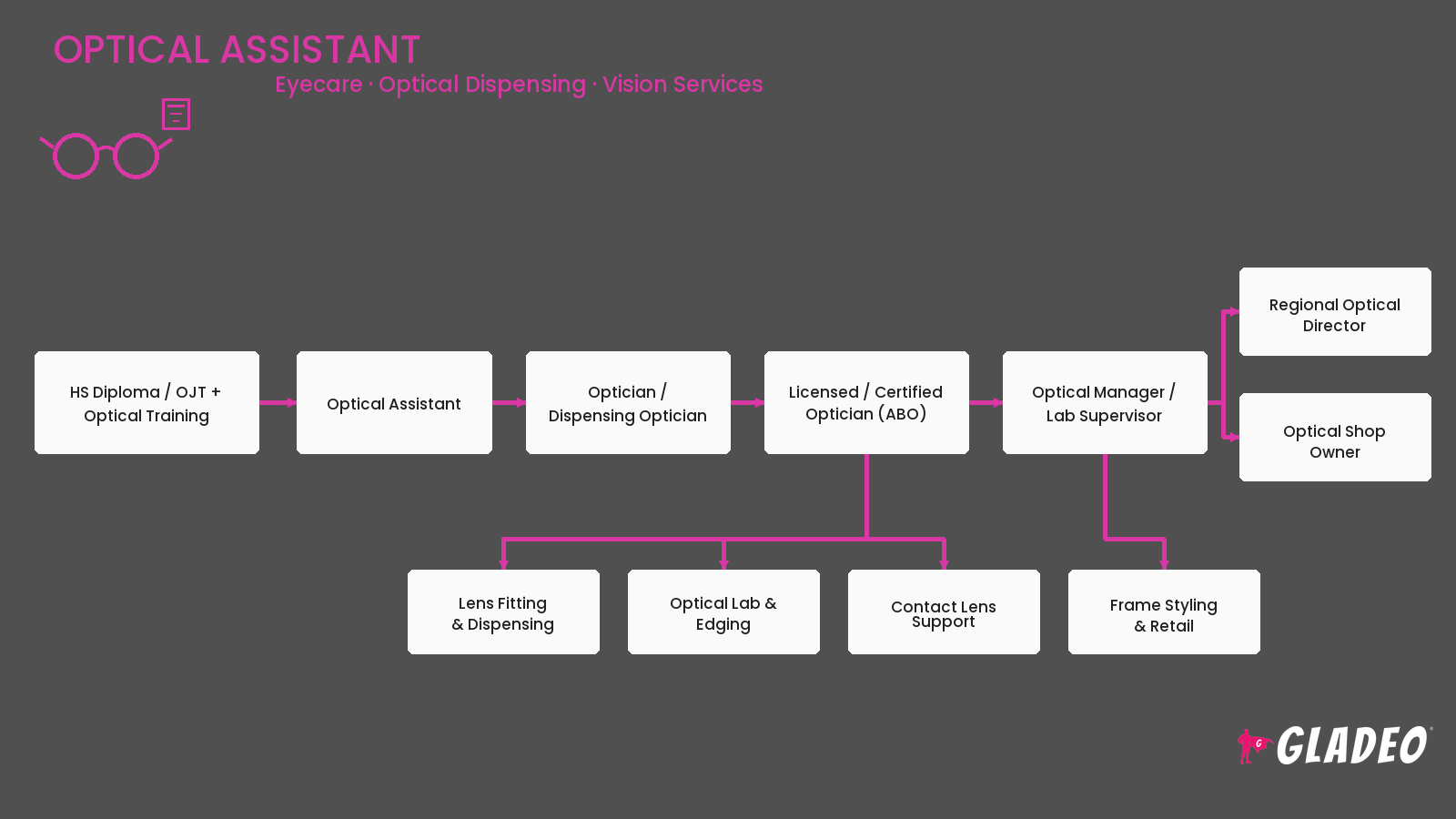
Becoming an Optical Assistant usually involves completing a high school diploma followed by specialized training in optical assisting. Many employers offer on-the-job training, and some regions require certification or licensing depending on the tasks performed.
Students can take courses in relevant subjects such as:
- Biology – basics of human anatomy and eye structure
- Mathematics – for measurements and calculations
- Health Science – understanding health and safety practices
- Customer Service – learning communication and interpersonal skills
- Fashion and Design – knowledge of style and trends in eyewear
- Computer Applications – managing records and orders digitally
- Physics – basics of light and lenses
- Technical Drawing – for understanding frame designs
- Psychology – to improve customer interaction skills
- Sales and Marketing – techniques for product promotion
Hands-on experience through internships or part-time jobs in optical shops is invaluable for building skills and confidence. Building a portfolio of customer service experiences and learning to use optical technology prepares you for success. Continuing education and certification can open doors to advanced roles.
- Take courses in biology, health science, and math to build a strong foundation.
- Join school clubs focused on healthcare, customer service, or fashion design.
- Volunteer or intern at local optical shops or clinics to gain experience.
- Learn basic computer skills and practice using point-of-sale systems.
- Develop strong communication skills through presentations and group projects.
- Attend career fairs and talk to professionals in optical fields.
- Practice measuring techniques with friends or family members.
- Stay updated on eyewear trends by reading fashion magazines and websites.
- Participate in workshops or short courses related to eye care or retail sales.
- Build a portfolio of your customer service and technical experiences.
- Choose programs that offer hands-on training with optical equipment.
- Look for courses that cover both customer service and technical skills.
- Seek programs with internship or externship opportunities in optical settings.
- Check if the program prepares you for certification exams if required.
- Ensure instructors have real-world experience in optical assisting.
- Find programs that teach current software used in optical practices.
- Verify the curriculum includes lessons on eyewear fashion and fitting.
- Look for schools with good relationships with local optical employers.
- Consider programs that offer flexible schedules or online components.
- Check if the program covers health and safety regulations.
- Look for classes that teach sales and marketing skills specific to optics.
- Choose programs recognized by professional optical associations.
- Apply to optical shops, eye clinics, and eyewear retailers for entry-level assistant positions.
- Prepare a resume highlighting customer service experience and interest in eye care.
- Develop a simple portfolio or list of skills and any relevant training.
- Practice clear communication and basic measurements to demonstrate readiness.
- Network by visiting local optical stores and introducing yourself to staff.
- Use online job boards focused on healthcare and retail to find openings.
- Prepare for interviews by researching common optical assistant duties and questions.
- Seek opportunities to shadow experienced Optical Assistants or opticians.
- Volunteer for community vision screenings or health fairs to gain experience.
- Ask for feedback from supervisors to improve skills on the job.
- Stay organized and punctual to build a strong reputation.
- Be open to part-time or temporary work to get your foot in the door.
- Gain certification as an Optical Assistant or Technician to increase job prospects.
- Develop expertise in advanced vision screening tools and fitting techniques.
- Build strong relationships with optometrists and opticians for mentorship.
- Expand knowledge of eyewear fashion trends and lens technology.
- Take courses in sales and customer relationship management.
- Pursue opportunities to train new staff or lead small teams.
- Consider continuing education to become a Licensed Optician or Optometrist Assistant.
- Stay updated on industry standards and emerging optical technologies.
Websites:
- American Optometric Association (AOA) - www.aoa.org
- Opticians Association of America - www.opticians.org
- National Federation of Opticianry Schools - www.nfos.org
- The Vision Council - www.thevisioncouncil.org
- Optical Women's Association - www.opticalwomen.com
- International Association of Contact Lens Educators - www.iacle.org
- Optical Lab Products - www.opticallabproducts.com
- Eyecare Business Magazine - www.eyecarebusiness.com
- Optometry Times - www.optometrytimes.com
- Job boards: Indeed Optical Assistant Jobs - www.indeed.com/q-Optical-Assistant-jobs.html
- LinkedIn Optical Assistant Careers - www.linkedin.com/jobs/optical-assistant-jobs
- Glassdoor Optical Assistant Reviews and Salaries - www.glassdoor.com
- Health Careers Network - www.healthcareersnetwork.com
Books:
- The Optician Training Manual by John Fitting
- Optical Dispensing by William J. Benjamin
- Eyewear: A Visual History by Caroline Evans
- Clinical Procedures in Primary Eye Care by David B. Elliott
- Contact Lens Practice by Nathan Efron
If you find that working as an Optical Assistant isn't the perfect fit, there are many related careers that use similar skills in healthcare, customer service, and technical support.
- Optician: Focuses more on fitting and dispensing eyewear independently.
- Optometrist Assistant: Works directly with eye doctors to assist with exams.
- Hearing Aid Specialist: Helps customers select and fit hearing devices.
- Pharmacy Technician: Assists pharmacists in preparing medications.
- Medical Receptionist: Manages patient appointments and front desk duties in clinics.
- Sales Associate in Medical Equipment: Sells specialized healthcare products.
- Vision Screener: Performs basic vision tests in schools or community centers.
- Customer Service Representative in Healthcare: Supports patients with insurance and appointments.
- Optical Lab Technician: Prepares lenses and assembles glasses behind the scenes.
- Health Educator: Teaches communities about eye health and preventive care.
Newsfeed

Featured Jobs
Online Courses and Tools
Annual Salary Expectations
New workers start around $47K. Median pay is $61K per year. Highly experienced workers can earn around $74K.