






Spotlights
Orientation and Mobility Specialist, Mobility Specialist, Certified Orientation and Mobility Specialist (COMS), Orientation and Mobility Instructor, Rehabilitation Therapist, Vision Rehabilitation Therapist, Certified Low Vision Therapist (CLVT), Occupational Therapist, Students with Visual Impairments Teacher (TVI), Visually Impaired Teacher (TVI), Rehabilitation Teacher
Imagine navigating a busy street confidently despite having limited or no vision — Orientation and Mobility Instructors make this independence possible for people with visual impairments. Their work transforms lives by teaching essential skills that empower individuals to move safely and freely in their communities.
Orientation and Mobility Instructors spend their days assessing clients’ vision challenges, customizing travel training plans, and teaching practical skills like using canes, electronic travel aids, or working with guide dogs. They collaborate closely with clients, families, and other specialists including occupational therapists and vision rehabilitation professionals to help each person meet their mobility goals.
Using specialized technology like screen magnifiers, electronic travel aids, and adaptive mobility devices, these instructors combine hands-on lessons with assistive tools. Their role is critical because mastering safe travel skills opens doors to independence, confidence, and full participation in everyday life.
- Helping clients gain life-changing independence and confidence in their mobility.
- Seeing clients master new skills that improve their safety and quality of life.
- Working one-on-one to build trusting relationships and tailor instruction to individual needs.
- Knowing your teaching directly impacts a person’s ability to live, work, and explore their community safely.
Working Schedule
Orientation and Mobility Instructors often work weekdays but may have flexible hours to accommodate clients' schedules. Many work in schools, rehabilitation centers, or community programs, and some are self-employed or freelance. The job requires travel to client homes, schools, or public places to provide real-world training. Deadlines revolve around client progress and program schedules, with a mix of structured appointments and hands-on fieldwork.
Typical Duties
- Conduct assessments to evaluate clients’ visual abilities and mobility challenges.
- Develop personalized orientation and mobility training plans based on client goals and needs.
- Teach cane techniques such as two-point touch, diagonal cane, and protective techniques.
- Instruct clients in using adaptive devices like guide dogs, electronic travel aids (ETAs), and other mobility aids.
- Train clients in route planning and safe navigation of various environments including streets and public transport.
- Monitor and document client progress through detailed reports and session notes.
- Collaborate with other specialists like occupational therapists, teachers, and family members to support client success.
- Provide counseling and support to help clients build confidence and overcome anxiety related to travel.
- Stay updated on new assistive technologies and mobility techniques to enhance training.
- Educate clients on safety tips and legal rights related to mobility and accessibility.
Additional Responsibilities
- Maintain accurate records for client assessments and training outcomes.
- Participate in professional development and certification renewal activities.
- Advocate for clients’ mobility needs within schools, workplaces, and community organizations.
- Develop educational materials and resources to support clients and caregivers.
- Conduct outreach and awareness programs about orientation and mobility services.
- Assist with technology troubleshooting and set-up related to mobility devices.
- Coordinate with healthcare providers for integrated client care.
- Support clients in accessing funding and resources for mobility equipment.
The morning often begins with reviewing client files, planning lesson objectives, and preparing specialized equipment like canes or electronic travel aids. Instructors may also attend team meetings with educators or therapists to coordinate care plans.
Midday is usually spent in hands-on training sessions with clients, practicing cane skills, navigation techniques, or using assistive technologies in real-world settings such as sidewalks, transit stations, or shopping centers. The instructor offers personalized feedback and encouragement.
Afternoons might involve documenting client progress, updating training plans, and consulting with families or medical professionals. Some days end with outreach activities or professional development to stay current on best practices and new mobility devices.
Soft Skills
- Patience to work at a client’s pace and build trust.
- Empathy to understand the challenges faced by visually impaired individuals.
- Clear communication to explain complex skills simply and effectively.
- Problem-solving to adapt training to unique client needs and environments.
- Attention to detail for monitoring client progress and safety.
- Physical stamina for walking, standing, and traveling with clients.
- Collaboration skills to work with healthcare teams and families.
- Confidence to teach skills that require client trust and independence.
- Adaptability to use evolving technology and methods.
- Emotional resilience to support clients through frustration or setbacks.
- Teaching ability to motivate and inspire clients.
- Cultural sensitivity to respect diverse backgrounds and experiences.
Technical Skills
- Proficiency with mobility devices like long canes and electronic travel aids.
- Knowledge of assistive technology software such as screen magnifiers and magnification programs.
- Ability to use database software for client records and reporting.
- Familiarity with presentation tools to create educational materials.
- Understanding of ergonomic principles for safe mobility training.
- Competence with GPS and navigation apps adapted for visually impaired users.
- Skill in setting up and troubleshooting electronic mobility aids.
- Basic proficiency in programming or configuring adaptive devices.
- Use of communication tools to connect with clients remotely if needed.
- Understanding of safety protocols and emergency procedures.
- School-Based Instructor: Provides orientation and mobility training within educational settings for students with visual impairments.
- Rehabilitation Instructor: Works in rehabilitation centers or hospitals to help adults regain mobility skills after vision loss.
- Community-Based Instructor: Offers independent living and travel training in clients’ neighborhoods and public spaces.
- Guide Dog Mobility Instructor: Specializes in training clients to work safely and effectively with guide dogs.
- Technology Specialist Instructor: Focuses on teaching clients to use electronic travel aids and adaptive tech devices.
- Pediatric Instructor: Works specifically with children to develop early mobility skills and confidence.
- Vocational Mobility Instructor: Supports clients in workplace navigation and job-related travel skills.
- Remote/Telepractice Instructor: Uses virtual tools to provide orientation and mobility training over distance.
- Public and private schools for the visually impaired
- Rehabilitation hospitals and centers
- Nonprofit organizations serving people with disabilities
- Government agencies providing disability services
- Vision care clinics and low vision centers
- Guide dog training organizations
- Community health and wellness centers
- Specialized mobility training companies
- Residential care facilities
- Assistive technology companies
- Vocational rehabilitation agencies
- University research and training programs
Orientation and Mobility Instructors often face high-pressure situations where client safety is paramount, requiring constant vigilance during travel training. Mistakes can have serious consequences, so instructors must maintain focus and composure.
Work hours can vary and sometimes extend beyond typical business hours to meet client needs, including evenings or weekends. Travel between client locations is frequent and may involve navigating busy or unpredictable environments.
The role requires emotional resilience as clients may experience frustration or fear during training. Instructors must be patient and supportive while managing multiple cases and documentation requirements, often balancing hands-on training with administrative duties.
- Increased use of electronic travel aids (ETAs) and smart canes with sensors to enhance safety.
- Growing integration of GPS and smartphone apps tailored for visually impaired navigation.
- Remote and virtual orientation and mobility training sessions becoming more common.
- Advancements in wearable technology to provide real-time guidance and obstacle detection.
- Greater focus on personalized training plans using data analytics and client feedback.
- Collaboration with augmented reality (AR) and artificial intelligence (AI) for mobility assistance.
- Rising demand for services due to an aging population with vision loss.
- Expanded community-based programs promoting inclusion and accessibility.
- Enhanced training certifications and continuing education standards.
- Increased awareness and advocacy around disability rights and mobility access.
Many Orientation and Mobility Instructors show early interest in helping others and strong empathy for people with disabilities or challenges. They often enjoy hands-on activities and problem-solving games that involve spatial awareness and navigation.
As kids, they might have been drawn to teaching or coaching roles, loved puzzles or mazes, and had a curiosity about technology and gadgets that assist people. Their passion for independence and safety often stems from personal experiences or family members with disabilities.
Becoming an Orientation and Mobility Instructor typically requires specialized training beyond high school, often including a degree in vision rehabilitation, special education, occupational therapy, or a related field. Certification through professional organizations is essential to ensure expertise and credibility.
Students can take courses in relevant subjects such as:
- Human Anatomy and Physiology
- Introduction to Visual Impairments
- Orientation and Mobility Techniques
- Assistive Technology for the Visually Impaired
- Rehabilitation Counseling
- Psychology of Disabilities
- Communication Skills
- Special Education Methods
- Ethics in Rehabilitation
- Community-Based Instruction
Hands-on experience through internships or practicum placements is crucial to develop practical skills. Building a strong portfolio of client case studies and obtaining certification from recognized bodies helps launch a successful career. On-the-job training and continuing education keep instructors current with evolving techniques and technologies.
- Take biology and health science classes to understand human anatomy and vision.
- Enroll in psychology and social studies courses to build empathy and communication skills.
- Join clubs or volunteer with organizations that support people with disabilities.
- Practice technology skills through computer or robotics classes.
- Seek internships or shadow professionals in rehabilitation or special education.
- Develop public speaking and teaching skills through presentations and leadership roles.
- Take courses in special education or disability studies if available.
- Explore community service opportunities related to mobility or accessibility.
- Learn about assistive technologies and how they help people.
- Focus on math and science classes to prepare for technical aspects of the role.
- Attend workshops or summer programs on visual impairment and rehabilitation.
- Build teamwork skills through sports or group projects.
- Choose programs accredited by recognized vision rehabilitation organizations.
- Look for courses that offer extensive hands-on orientation and mobility training.
- Ensure access to assistive technology labs and equipment.
- Consider programs with strong internship or practicum partnerships.
- Check if faculty have real-world O&M instructional experience.
- Seek programs that cover both low vision therapy and mobility skills.
- Find schools offering certification preparation courses.
- Evaluate student support services for career placement and mentoring.
- Prioritize curriculum that includes ethics and counseling techniques.
- Look for courses on adaptive technology and emerging tools.
- Select programs that emphasize community-based training approaches.
- Consider flexible learning options, including online modules for theory components.
- Volunteer or intern with organizations serving visually impaired individuals to gain experience.
- Build a portfolio with detailed case studies and client progress reports.
- Apply for entry-level positions like assistant mobility instructor or rehabilitation aide.
- Network with professionals through associations or events.
- Prepare a demo lesson showcasing mobility techniques and teaching skills.
- Seek mentorship from experienced instructors.
- Develop proficiency with common assistive devices and software.
- Attend workshops and certification courses to enhance credentials.
- Practice clear and compassionate communication for client interactions.
- Gain experience in diverse settings such as schools, clinics, or community centers.
- Learn to document client progress accurately using database software.
- Stay informed about latest mobility technologies and training methodologies.
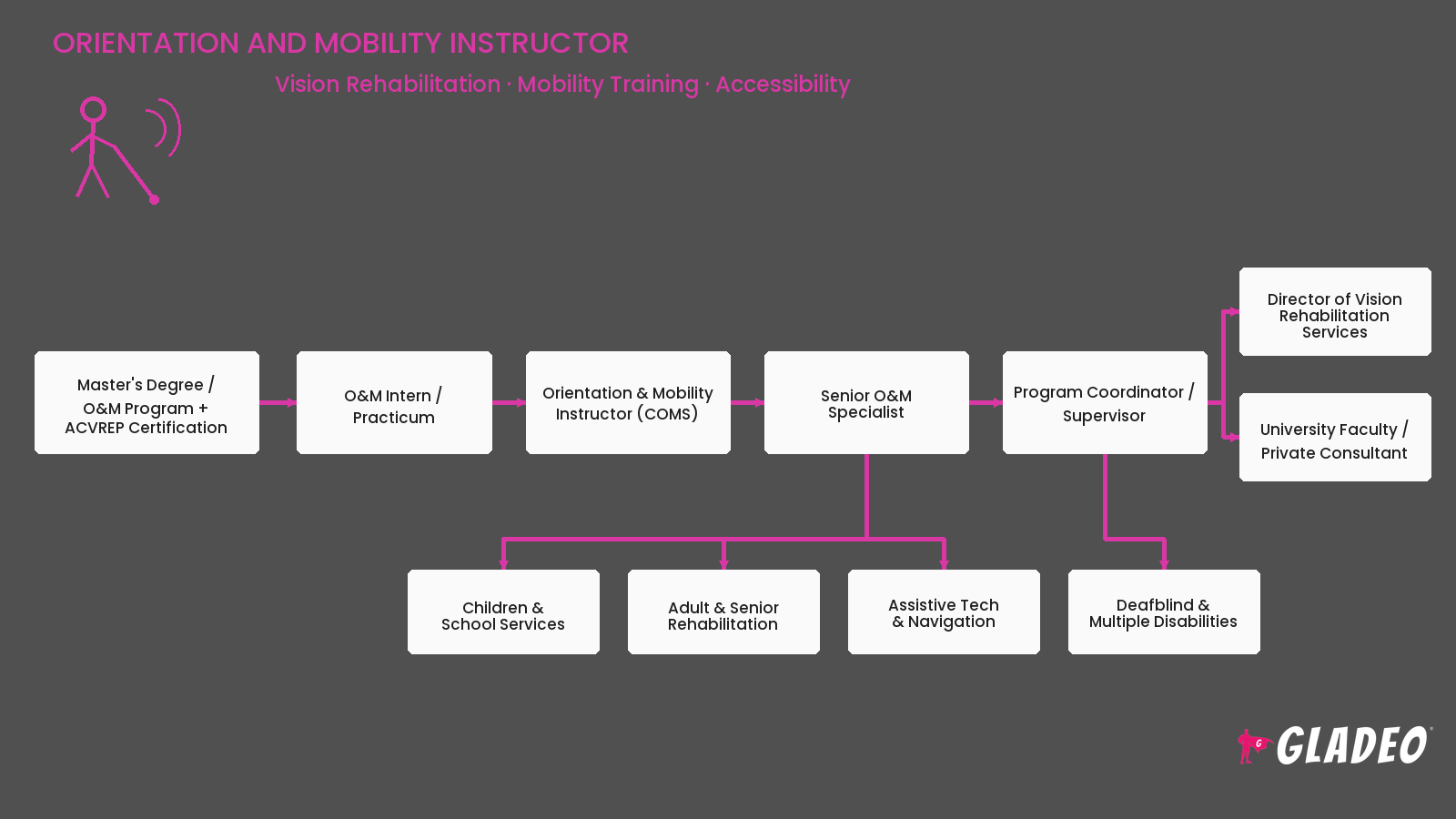
- Earn advanced certification such as Certified Orientation and Mobility Specialist (COMS).
- Specialize in working with particular populations like children or seniors.
- Develop expertise in emerging mobility technologies and electronic travel aids.
- Take leadership roles in program development or training new instructors.
- Pursue continuing education in rehabilitation counseling or assistive technology.
- Build a professional network through conferences and industry groups.
- Contribute to research or advocacy efforts in vision rehabilitation.
- Expand service offerings to include remote or virtual training options.
Websites:
- American Foundation for the Blind (AFB) - afb.org
- Association for Education and Rehabilitation of the Blind and Visually Impaired (AER) - aerbvi.org
- National Federation of the Blind (NFB) - nfb.org
- VisionAware - visionaware.org
- Helen Keller National Center - hkNC.org
- National Industries for the Blind (NIB) - nib.org
- Orientation and Mobility Professionals Association - omaed.org
- American Occupational Therapy Association (AOTA) - aota.org
- Low Vision International - lowvisiononline.com
- Rehabilitation Engineering and Assistive Technology Society of North America (RESNA) - resna.org
- Hadley Institute for the Blind and Visually Impaired - hadley.edu
- Job Accommodation Network (JAN) - askjan.org
- National Association for Parents of Children with Visual Impairments (NAPVI) - napvi.org
- Braille Institute - brailleinstitute.org
Books:
- Foundations of Orientation and Mobility by William R. Wiener, Richard L. Welsh, Bruce A. Blasch
- Introduction to Orientation and Mobility Techniques by William R. Wiener and Richard L. Welsh
- Assistive Technology for Visually Impaired and Blind People by Marion A. Hersh, Michael A. Johnson
- Orientation and Mobility Techniques: A Guide for the Practitioner by Robert J. Batshaw
- Low Vision: Principles and Practice by Peggy R. Ashford
If you love helping people with disabilities but want a different focus or work environment, several related careers offer rewarding paths to support independence and accessibility.
- Occupational Therapist specializing in visual impairments
- Vision Rehabilitation Therapist
- Special Education Teacher for students with visual impairments
- Assistive Technology Specialist
- Rehabilitation Counselor
- Speech-Language Pathologist
- Physical Therapist
- Social Worker with disability focus
- Guide Dog Trainer
- Community Health Worker
Newsfeed

Featured Jobs
Online Courses and Tools
Annual Salary Expectations
New workers start around $0K. Median pay is $0K per year. Highly experienced workers can earn around $0K.