






Spotlights
Fiber Optics Technician, Laser Technician, Optomechanical Technician, Photonic Laboratory Technician, Photonics Technician, Ruling Technician, Optical Technician, Laser Systems Technician, Fiber Optic Installer, Photonic Equipment Technician, Optical Assembly Technician, Laser Equipment Technician
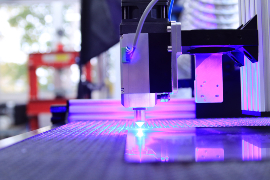
When you look through a fiber optic cable or watch a laser light show, you might not realize the precision work that goes behind the scenes to make those beams sharp and reliable. Photonics Technicians are the experts who build, test, and maintain the high-tech systems that manipulate light for everything from communication networks to medical devices.
Every day, Photonics Technicians assemble and adjust complex optical equipment such as lasers, lenses, mirrors, and fiber optic cables. They collaborate closely with engineers, scientists, and quality control teams to ensure each device performs perfectly. Whether calibrating a laser system or testing fiber optic sensors, they make sure the technology is safe, efficient, and ready to power the next wave of innovation.
Using specialized tools like spectrometers, interferometers, and optical spectrum analyzers, Photonics Technicians measure and fine-tune light-based systems. They rely on software for data collection and analysis, and maintain cleanroom environments to protect sensitive equipment. Their work is critical to advancing telecommunications, medical imaging, manufacturing, and more.
- Knowing your precision work powers crucial technologies like high-speed internet and laser surgeries.
- Being part of cutting-edge developments in fields like telecommunications and healthcare.
- Solving complex problems with hands-on technology and scientific knowledge.
- Working in a clean, high-tech lab environment where attention to detail matters.
Working Schedule
Photonics Technicians usually work full-time in cleanroom labs or manufacturing settings, often during regular business hours. However, some projects may require overtime or shift work to meet tight deadlines or support continuous production. The job demands focus, steady hands, and the ability to work independently or as part of a team.
Typical Duties
- Assemble optical and fiber optic components with precision tools.
- Calibrate and adjust lasers, microscopes, and interferometers to exact specifications.
- Maintain cleanroom standards to avoid contamination of sensitive equipment.
- Perform tests using spectrometers and beam analyzers to gather photonic data.
- Document calibration procedures and test results accurately.
- Set up and operate assembly machines like die bonders and wire bonders.
- Use computer software to acquire and analyze data from optical tests.
- Inspect components for defects or misalignments under microscopes.
- Troubleshoot equipment malfunctions and perform routine maintenance.
- Collaborate with engineers to implement design changes and improvements.
- Ensure compliance with safety and quality standards during assembly and testing.
- Train new technicians on operating procedures and cleanroom protocols.
Additional Responsibilities
- Maintain detailed logs and reports for quality assurance.
- Order and manage inventory of optical parts and supplies.
- Assist in developing new testing methodologies for emerging photonic technologies.
- Participate in team meetings to discuss project progress and challenges.
- Support installation of photonic equipment at client sites if needed.
- Follow strict safety guidelines when handling lasers and electronic devices.
- Continuously update knowledge on photonics industry advancements.
- Help in creating user manuals and technical documentation for equipment.
Mornings often start with reviewing test plans and calibrating equipment to prepare for the day's experiments or assembly tasks. Photonics Technicians check all tools and cleanroom gear to ensure the environment meets contamination control standards.
Midday involves hands-on work assembling fiber optic cables or adjusting laser systems, monitoring precise measurements using specialized instruments, and entering data into analysis software. They frequently communicate with engineers about results or any technical issues found.
Afternoons might include troubleshooting equipment, documenting findings, and maintaining cleanroom conditions. Technicians may also attend team meetings to align on project goals or train junior staff, wrapping up with preparation for the next day’s work.
Soft Skills
- Attention to detail
- Problem-solving mindset
- Strong communication skills
- Patience and precision
- Team collaboration
- Adaptability
- Time management
- Manual dexterity
- Critical thinking
- Following strict safety protocols
- Ability to work under pressure
- Curiosity and eagerness to learn
Technical Skills
- Operating spectrometers and interferometers
- Using optical alignment tools
- Proficiency with data acquisition software
- Experience with CAD programs like AutoCAD and SolidWorks
- Knowledge of laser calibration techniques
- Familiarity with cleanroom standards
- Understanding fiber optic cable assembly
- Using statistical analysis software
- Ability to troubleshoot photonic equipment
- Competence with optical spectrum analyzers
- Fiber Optics Technician: Focuses on installing and maintaining fiber optic cables and communication systems.
- Laser Technician: Specializes in assembling and calibrating laser devices for various applications.
- Optomechanical Technician: Works on integrating mechanical and optical components in devices.
- Photonic Laboratory Technician: Supports research by preparing and testing photonic experiments in labs.
- Ruling Technician: Creates precise diffraction gratings used in optical instruments.
- Optical Assembly Technician: Builds and tests optical assemblies like lenses and mirrors for equipment.
- Laser Systems Technician: Maintains and repairs complex laser systems in industrial or medical settings.
- Photonic Equipment Technician: Oversees operation and repair of photonics manufacturing machinery.
- Telecommunications companies
- Medical device manufacturers
- Optical instrument manufacturers
- Research universities and laboratories
- Semiconductor manufacturing firms
- Defense and aerospace contractors
- Cleanroom manufacturing facilities
- Fiber optic installation companies
- Laser technology companies
- Quality control and testing labs
- Photonics research institutes
- Industrial automation firms
Working as a Photonics Technician requires excellent focus and steady hands because even a tiny misalignment can affect laser beams or optical signals. Precision and patience are vital, especially when working with delicate equipment in cleanrooms where contamination must be avoided.
Hours typically follow a standard 40-hour workweek, but project deadlines can push technicians to work overtime or weekends. The job can be mentally demanding due to the need for constant problem-solving, careful measurements, and documentation.
While the role offers a high-tech environment, it can be physically taxing standing for long periods and requires adherence to strict safety procedures to handle lasers and electrical devices safely. Technicians must be prepared for iterative testing and adjustments, which means repetitive tasks until the perfect calibration is achieved.
- Growing demand for faster, more reliable fiber optic networks.
- Increased use of photonics in medical imaging and laser surgery.
- Advancements in laser technology enabling miniaturization of devices.
- Integration of automation and robotics in optical assembly processes.
- Development of new materials for more efficient photonic components.
- Use of AI and machine learning to analyze photonic data.
- Expansion of cleanroom technology for contamination control.
- Rising importance of sustainability in manufacturing photonic devices.
- Improvement in software tools for optical design and simulation.
- Collaboration between photonics and quantum computing research.
Many Photonics Technicians discovered their passion through interests in science, especially physics and optics, during middle and high school. They often enjoyed hands-on activities like building models, experimenting with light and lenses, or tinkering with electronics.
These future technicians tended to be curious problem solvers who liked figuring out how things work and enjoyed precise, detail-oriented tasks. Early hobbies might include amateur astronomy, photography, or coding simple software related to data analysis.
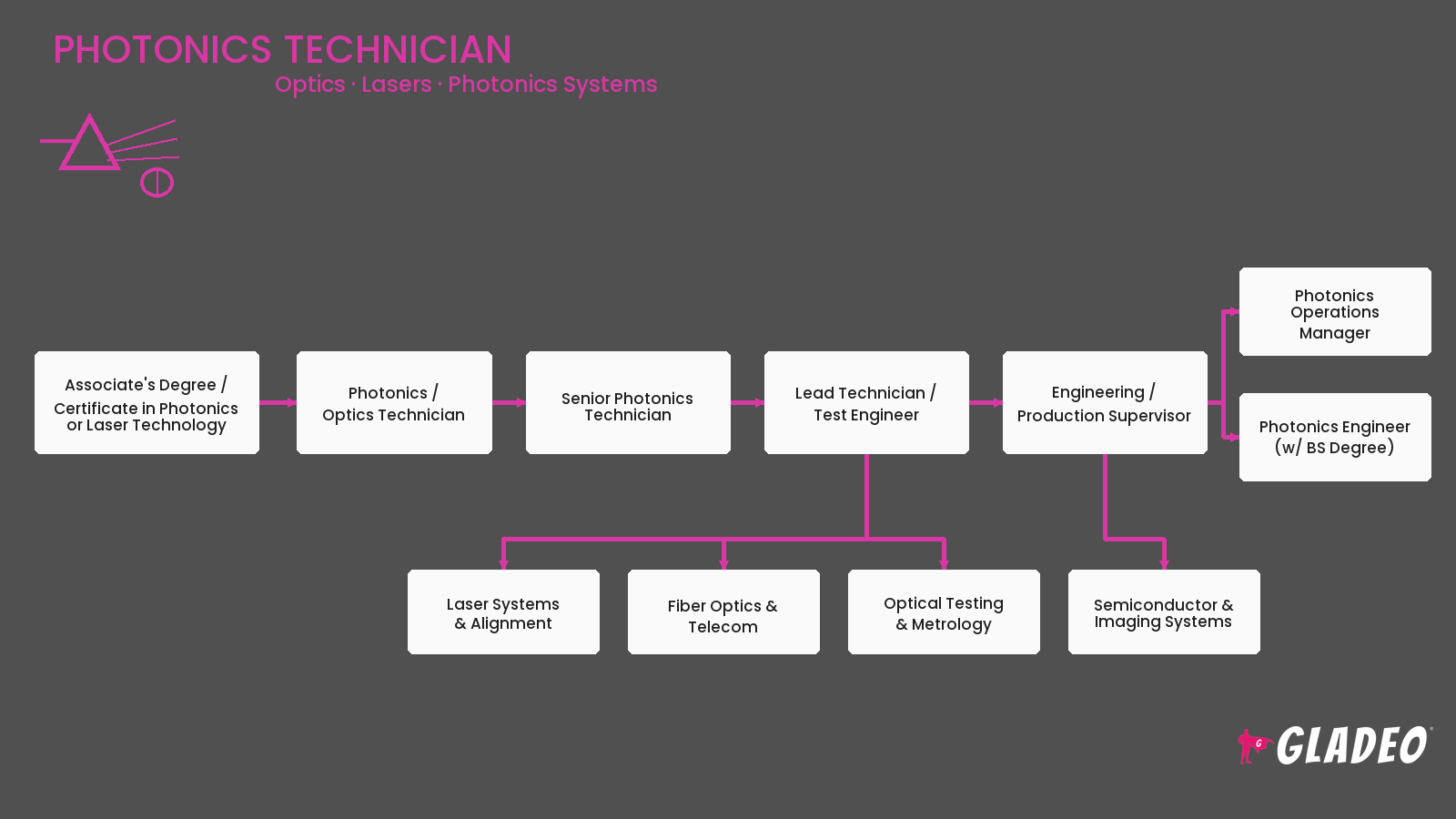
Becoming a Photonics Technician typically involves a combination of formal education and hands-on training. Many technicians start with an associate degree or technical certificate in photonics, optics, or electronics, where they learn about light behavior, laser safety, and equipment operation.
Students can take courses in relevant subjects such as:
- Physics, especially optics and electromagnetism
- Electronics and electrical circuits
- Laser technology and safety procedures
- Fiber optic communication systems
- Computer-aided design (CAD) software
- Data acquisition and analysis software
- Mathematics including algebra and statistics
- Quality control and calibration techniques
- Manufacturing processes and cleanroom protocols
- Technical writing and documentation
Gaining practical experience through internships or co-op programs is key for success. Building a portfolio of projects, such as fiber optic assembly or laser calibration, can showcase skills to employers. Many Photonics Technicians also receive on-the-job training to master company-specific equipment and procedures.
- Take advanced science courses like physics and chemistry.
- Enroll in computer science or programming classes.
- Join STEM clubs or robotics teams to build hands-on skills.
- Attend workshops or camps focused on optics or lasers.
- Seek internships or volunteer in labs related to photonics.
- Practice technical writing to communicate complex ideas clearly.
- Learn basic electronics and soldering techniques.
- Develop math skills, focusing on algebra and statistics.
- Explore CAD software through online tutorials or classes.
- Participate in science fairs with projects involving light or lasers.
- Research colleges offering photonics or optical engineering programs.
- Consider technical schools with specialized photonics training.
- Look for programs accredited by recognized technical education bodies.
- Choose schools offering hands-on lab experiences and cleanroom training.
- Ensure curriculum covers laser safety and fiber optic technologies.
- Check if the program teaches relevant software like AutoCAD and MATLAB.
- Consider schools with strong industry connections for internships.
- Find programs that emphasize teamwork and communication skills.
- Look for opportunities to work on real-world photonics projects.
- Verify availability of up-to-date equipment and facilities.
- Seek instructors with industry experience in photonics.
- Check if the program supports certification preparation.
- Evaluate class sizes for personalized instruction.
- Confirm the program offers career services and job placement support.
- Create a strong resume highlighting relevant coursework and hands-on projects.
- Build a portfolio showing assembly, calibration, or testing work.
- Apply for internships or entry-level technician roles in manufacturing or labs.
- Network with industry professionals through career fairs and online groups.
- Prepare for interviews by practicing technical questions about optics and lasers.
- Obtain certifications in laser safety or fiber optics if possible.
- Volunteer for lab assistant roles to gain experience.
- Use job boards focused on photonics and manufacturing careers.
- Reach out to alumni or mentors for guidance and referrals.
- Learn to use common photonic software tools to boost your qualifications.
- Demonstrate reliability and attention to detail during interviews.
- Be ready to start with routine tasks and learn on the job.
- Gain certifications in advanced laser systems or fiber optic technologies.
- Develop expertise in photonic design software like ZEMAX or SolidWorks.
- Take on responsibilities managing quality control or calibration teams.
- Build relationships with engineers and project managers for mentorship.
- Lead training sessions for new technicians to demonstrate leadership.
- Stay updated with industry trends and continuing education.
- Pursue further education such as a bachelor’s degree in optical engineering for advancement.
- Aim for roles like photonics engineer assistant or lab supervisor.
Websites:
- The Optical Society (OSA) - www.osa.org
- SPIE, the international society for optics and photonics - www.spie.org
- Photonics Media - www.photonics.com
- Fiber Optic Association - www.thefoa.org
- Laser Institute of America - www.lia.org
- Optical Fiber Technology Journal - www.journals.elsevier.com/optical-fiber-technology
- American Society for Engineering Education (ASEE) - www.asee.org
- National Institute of Standards and Technology (NIST) - www.nist.gov
- Photonics Spectra - www.photonics.com/spectra
- International Society for Optics and Photonics (ISOP) - www.isop.org
- Electronics Technician Association International - www.etai.org
- Cleanroom Technology - www.cleanroomtechnology.com
- Autodesk Education - www.autodesk.com/education
- Dassault Systèmes SolidWorks - www.solidworks.com
Books:
- Introduction to Fiber Optics by John Crisp
- Laser Fundamentals by William T. Silfvast
- Optics by Eugene Hecht
- Photonics: Optical Electronics in Modern Communications by Amnon Yariv and Pochi Yeh
- Fundamentals of Photonics by Bahaa E. A. Saleh and Malvin Carl Teich
If a career as a Photonics Technician doesn’t work out or you want to explore related fields, there are many options that use similar skills in optics, electronics, or technical problem solving.
- Electronics Technician
- Optical Engineer
- Quality Control Inspector
- Manufacturing Technician
- Laser Safety Officer
- Research Assistant in Photonics
- Fiber Optic Installer
- Technical Sales Specialist for Optical Equipment
- Calibration Technician
- Mechatronics Technician
Newsfeed

Featured Jobs
Online Courses and Tools
Annual Salary Expectations
New workers start around $63K. Median pay is $82K per year. Highly experienced workers can earn around $99K.