





Spotlights
Plant Biochemist, Plant Molecular Scientist, Plant Research Chemist, Agricultural Chemist, Plant Physiology Chemist, Phytochemist, Botanical Chemist, Crop Science Chemist, Plant Metabolism Scientist, Plant Biotechnology Chemist, Plant Chemistry Analyst, Environmental Plant Chemist
Imagine the food you eat, the medicines you rely on, and the fuels that power our world all coming from plants — and behind those advances is the work of Plant Chemists who unlock the secrets of plant chemistry to improve these essentials.
Plant Chemists spend their days experimenting with plant compounds to understand how they grow, defend themselves, and produce useful chemicals. They collaborate with biologists, agronomists, pharmacologists, and environmental scientists to develop new crops, natural products, or sustainable solutions. Their work leads to innovations like disease-resistant plants, natural pesticides, or plant-based medicines.
Using high-tech lab equipment such as chromatography machines, spectrometers, and molecular analyzers, Plant Chemists identify and test plant chemicals. This role is crucial in developing safer, greener products and advancing agriculture, health, and environmental sustainability for people worldwide.
- Contributing to sustainable agriculture and healthier food sources that benefit society
- Discovering new plant compounds that can lead to life-saving medicines or eco-friendly products
- Working at the intersection of chemistry and biology to solve real-world problems
- Seeing your research lead to innovations that impact farming, medicine, or environmental conservation
Working Schedule
Plant Chemists typically work standard full-time hours in laboratory or research settings, but project deadlines or experiments may require extra hours or weekend work. Many work in universities, government labs, or private companies, balancing hands-on lab work with meetings and data analysis. Some positions involve fieldwork, adding variety to the schedule.
Typical Duties
- Design and conduct experiments to analyze chemical processes in plants
- Extract and identify plant compounds using chemical techniques
- Develop new plant-based products such as medicines, pesticides, or biofuels
- Collaborate with cross-disciplinary teams including biologists and agronomists
- Analyze data and interpret results to guide research direction
- Prepare technical reports and research publications
- Ensure lab safety and compliance with environmental regulations
- Maintain and calibrate laboratory instruments and equipment
- Stay updated on advances in plant chemistry and biotechnology
- Assist in grant writing and funding proposals
- Test plant responses to environmental stresses or chemicals
- Support scale-up of successful lab findings to production processes
Additional Responsibilities
- Present research findings at conferences or to stakeholders
- Train junior scientists and lab technicians
- Participate in peer review of scientific papers
- Develop standard operating procedures for lab work
- Contribute to patent applications for new plant products
- Engage with regulatory agencies on product approvals
- Manage lab budgets and resource allocation
- Lead or support interdisciplinary research projects
Mornings often start with reviewing overnight experiment data or planning new tests, ensuring all materials and instruments are ready for the day’s work. Plant Chemists may participate in team meetings to discuss progress and troubleshoot challenges.
Midday is usually hands-on in the lab, running chemical analyses like chromatography or spectroscopy, preparing plant samples, and recording detailed observations. Collaboration with biologists or technicians happens frequently to integrate chemical and biological data.
Afternoons might involve interpreting experimental results, writing research papers or reports, and planning next steps. Some time is spent communicating with supervisors, funding agencies, or industry partners about project goals and outcomes.
Soft Skills
- Curiosity and passion for scientific discovery
- Strong attention to detail and accuracy
- Good communication skills for explaining complex concepts
- Critical thinking to analyze data and solve problems
- Teamwork and collaboration across disciplines
- Patience and persistence during long experiments
- Organizational skills to manage multiple projects
- Adaptability to new methods and technologies
- Ethical responsibility in research conduct
- Time management to meet deadlines
- Creativity in experimental design
- Ability to handle constructive criticism
Technical Skills
- Knowledge of organic and inorganic chemistry
- Experience with chromatography and spectroscopy techniques
- Proficiency in lab safety protocols
- Familiarity with molecular biology methods
- Data analysis and statistical software skills
- Chemical extraction and purification techniques
- Use of lab instruments like HPLC and GC-MS
- Understanding of plant physiology and biochemistry
- Ability to prepare scientific reports and publications
- Competence in grant writing and research documentation
- Phytochemist: Focuses on identifying and studying chemical compounds in plants.
- Agricultural Chemist: Specializes in chemicals affecting crop growth and protection.
- Plant Molecular Chemist: Studies plant molecules at the genetic and cellular level.
- Environmental Plant Chemist: Researches plant interactions with pollutants and environmental factors.
- Plant Metabolism Specialist: Investigates chemical pathways within plants.
- Plant Biotechnology Chemist: Applies chemistry to develop genetically modified plants.
- Natural Product Chemist: Extracts and analyzes medicinal compounds from plants.
- Crop Science Chemist: Works on improving crop yields and resistance through chemistry.
- Universities and research institutions
- Pharmaceutical companies
- Agricultural biotech firms
- Government agricultural research agencies
- Environmental research organizations
- Food and beverage companies
- Chemical manufacturing companies
- Nonprofit environmental groups
- Agronomy consulting firms
- Biofuel research centers
- Plant breeding companies
- Regulatory agencies overseeing plant products
Plant Chemists work in environments that require precision and care, often handling delicate plant samples and hazardous chemicals. The role can involve repetitive tasks and long hours analyzing data or troubleshooting experiments, which demands focus and patience.
Deadlines can be tight, especially when projects depend on seasonal plant growth or funding cycles. Experiment failures are common, requiring resilience and problem-solving skills to adjust methods and try again.
While most work is in labs, some roles include field visits to collect samples or test crops, which can expose workers to various weather conditions. The career requires ongoing learning to keep up with evolving scientific knowledge and technologies.
- Growing use of genetic editing tools like CRISPR to modify plant chemistry
- Increased demand for sustainable, plant-based products in medicine and industry
- Advances in analytical instruments improving chemical detection sensitivity
- Integration of bioinformatics and data science in plant chemistry research
- Focus on developing crops resistant to climate change stresses
- Collaboration between chemists and biotechnologists for innovative solutions
- Expansion of natural pesticide and herbicide research
- Use of automation and robotics in plant chemistry labs
- Emphasis on reducing environmental impact of agricultural chemicals
- Growth of personalized medicine using plant-derived compounds
Many Plant Chemists loved exploring nature as kids, fascinated by plants, flowers, and how things grow. They enjoyed hands-on activities like gardening, collecting leaves, or experimenting with natural materials at home or in school science projects.
They often showed curiosity about how plants can be used for food, medicine, or other purposes, and were drawn to science classes, especially chemistry and biology, where they could learn more about living things and chemicals.
Becoming a Plant Chemist usually means earning a bachelor's degree in chemistry, biochemistry, plant science, or a related field. Advanced research roles often require a master's or PhD specializing in plant chemistry or plant biology.
Students can take courses in relevant subjects such as:
- General Chemistry
- Organic Chemistry
- Biochemistry
- Plant Biology
- Analytical Chemistry
- Molecular Biology
- Environmental Science
- Agricultural Science
- Statistics and Data Analysis
- Laboratory Techniques
Hands-on lab work and internships during college help build practical skills. Many scientists gain experience through research assistant positions or cooperative education programs. Graduate studies deepen specialization and prepare for higher-level research positions.
- Take advanced science classes like chemistry and biology in high school
- Join science clubs or participate in science fairs
- Volunteer or intern in university labs or agricultural research centers
- Practice laboratory safety and techniques
- Develop strong math skills for data analysis
- Learn computer skills for data management
- Read scientific journals or popular science books
- Attend workshops or summer camps focused on plant science
- Build a portfolio of science projects
- Seek mentorship from science teachers or professionals
- Explore chemistry and biology dual coursework
- Consider undergraduate programs with research opportunities
- Look for programs with strong chemistry and plant science departments
- Choose schools offering modern lab facilities and equipment
- Seek programs with internship or cooperative education options
- Find opportunities to work on research projects with faculty
- Check for courses in biotechnology and molecular biology
- Evaluate faculty expertise in plant chemistry or related areas
- Consider programs with partnerships in agriculture or pharma industries
- Look for programs teaching data analysis and lab management
- Assess availability of scholarships or research funding
- Find schools with active science clubs or student organizations
- Prioritize programs with career services for science students
- Choose programs encouraging interdisciplinary collaboration
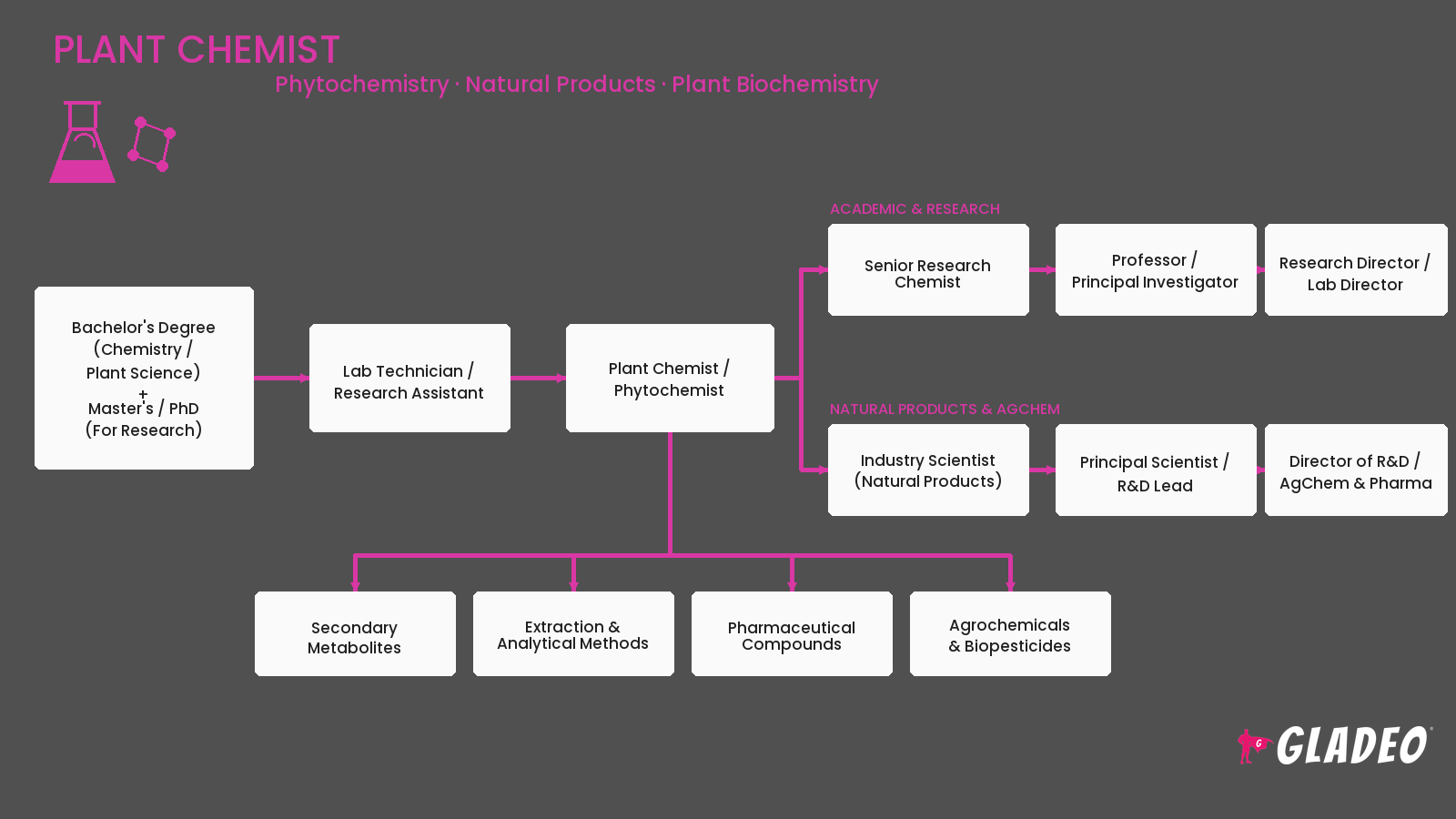
- Apply for research assistant or lab technician roles in university or industry labs
- Build a strong resume highlighting lab experience and coursework
- Create a portfolio of research projects or science fair achievements
- Network with professors, peers, and professionals at conferences
- Gain experience with common lab instruments and software
- Be prepared to assist with routine lab tasks and data entry
- Develop good communication skills for teamwork and reporting
- Stay organized and detail-oriented in experiments
- Seek mentorship and feedback to improve skills
- Attend workshops or training sessions to learn new techniques
- Be open to entry-level roles to gain practical experience
- Follow safety protocols rigorously
- Pursue graduate degrees to specialize and access advanced research roles
- Publish scientific papers to build reputation
- Develop leadership skills to manage research teams
- Network with industry professionals and academic mentors
- Stay updated on emerging technologies and methods
- Seek opportunities to lead projects or write grant proposals
- Gain experience in interdisciplinary collaboration
- Consider certifications or workshops to enhance technical skills
Websites:
- American Chemical Society (ACS)
- Society for Experimental Biology
- Plant Biology Division of the American Society of Plant Biologists
- Crop Science Society of America
- International Society of Plant Molecular Biology
- National Institute of Food and Agriculture
- U.S. Department of Agriculture (USDA)
- Biotechnology Innovation Organization (BIO)
- National Science Foundation (NSF) Plant Genome Research Program
- Science Careers
- ResearchGate
- PubMed Central
- Plant Physiology Journal
- Journal of Agricultural and Food Chemistry
Books:
- Introduction to Plant Biochemistry by Franklin D. West
- Plant Physiology and Development by Lincoln Taiz and Eduardo Zeiger
- Biochemistry & Molecular Biology of Plants by Bob B. Buchanan, Wilhelm Gruissem, and Russell L. Jones
- Phytochemistry: Advances in Research by Jeffrey B. Harborne
- The Chemistry and Biology of Isoflavonoids by David E. V. H. Jones
If a career as a Plant Chemist doesn’t pan out or you want to explore other paths, many related science and research roles can also be exciting and fulfilling.
- Agronomist
- Environmental Scientist
- Biotechnologist
- Pharmacologist
- Food Scientist
- Chemical Technician
- Molecular Biologist
- Horticulturist
- Microbiologist
- Quality Control Analyst
Click here to download the infographic
Newsfeed

Featured Jobs
Online Courses and Tools