





Spotlights
Botanical Geographer, Plant Ecologist, Vegetation Scientist, Landscape Botanist, Phytogeographer, Plant Distribution Specialist, Environmental Botanist, Plant Biogeographer, Flora Analyst, Conservation Botanist, Ecological Surveyor, Habitat Botanist
Imagine standing in a vast forest or a sprawling meadow, understanding not just the plants you see, but how they fit into the story of the Earth’s climate, history, and future. Plant Geographers reveal these stories by mapping where plants grow and why, helping us protect fragile ecosystems and manage our natural world better.
Plant Geographers spend their days studying the distribution of plants across different landscapes and climates. They collect data from field surveys, analyze satellite images, and work with other scientists like ecologists, climatologists, and conservationists to understand how environmental factors affect plant life. Their work helps predict how plants might respond to changes like climate shifts or human development.
Using tools like Geographic Information Systems (GIS), remote sensing technologies, and statistical software, Plant Geographers transform raw data into detailed maps and models. These insights guide land management, conservation efforts, and even agricultural planning, making their role critical in preserving biodiversity and supporting sustainable ecosystems.
- Helping protect endangered plant species and their habitats for future generations.
- Solving environmental puzzles that connect plants, climate, and geography.
- Collaborating with scientists and policymakers to make a real-world impact.
- Working outdoors in diverse, beautiful natural settings while conducting research.
Working Schedule
Plant Geographers often split their time between outdoor fieldwork and indoor research or data analysis. Fieldwork can require irregular hours depending on weather and seasonal plant cycles, while office work follows a more standard schedule. Many work full-time, but projects may involve intense periods of deadlines or travel. Employment can be with universities, government agencies, or environmental organizations, sometimes on contract or grant-funded roles.
Typical Duties
- Survey plant populations in various ecosystems to record species and abundance.
- Use GPS and mapping tools to document plant locations.
- Analyze soil, climate, and topography data to understand plant distribution.
- Create maps and models using Geographic Information Systems (GIS).
- Study historical plant distribution through herbarium records and satellite imagery.
- Collaborate with ecologists, climatologists, and land managers on research projects.
- Publish findings in scientific journals and present at conferences.
- Advise conservation groups or government agencies on plant habitat protection.
- Monitor changes in vegetation related to climate change or human activity.
- Develop predictive models on how plant distributions may shift in the future.
- Train or supervise field assistants during surveys.
- Ensure data quality and proper documentation for long-term studies.
Additional Responsibilities
- Apply for research grants or funding to support projects.
- Conduct environmental impact assessments related to plant communities.
- Educate the public or students about plant geography and conservation.
- Participate in interdisciplinary teams addressing ecosystem challenges.
- Maintain and update plant databases and geographic information systems.
- Develop management plans for invasive species control.
- Advocate for policies that protect plant biodiversity.
- Engage with indigenous communities and respect local ecological knowledge.
Morning often starts by reviewing data collected during previous field trips and planning the day’s surveys, checking weather conditions and coordinating with team members.
Midday might involve heading out to natural sites with GPS devices, notebooks, and sampling equipment to identify and record plant species, or spending time in the lab analyzing soil samples and plant characteristics.
Afternoons are typically for entering data into GIS software, collaborating with colleagues to interpret results, writing reports, or preparing presentations for stakeholders and funding agencies.
Soft Skills
- Attention to detail
- Critical thinking
- Problem-solving
- Communication
- Collaboration
- Patience
- Adaptability
- Curiosity
- Organizational skills
- Perseverance
- Observation skills
- Cultural sensitivity
Technical Skills
- Geographic Information Systems (GIS)
- Remote sensing technology
- Plant identification and taxonomy
- Data analysis and statistics
- Field survey techniques
- Scientific report writing
- GPS navigation
- Soil sampling methods
- Use of herbarium and botanical databases
- Environmental modeling software
- Conservation Plant Geographer: Focuses on protecting endangered plant species and habitats.
- Agricultural Plant Geographer: Studies crop distributions and how environmental factors affect agricultural productivity.
- Urban Plant Geographer: Examines plant life and green spaces in city environments.
- Climate Change Plant Geographer: Investigates how climate shifts impact plant distributions and ecosystems.
- Historical Plant Geographer: Uses fossil records and historical data to study past plant distributions.
- Restoration Plant Geographer: Works on restoring damaged ecosystems by reintroducing native plants.
- Invasive Species Specialist: Studies and manages the spread of non-native plants threatening ecosystems.
- Remote Sensing Specialist: Focuses on using satellite and aerial imagery to study plant patterns from afar.
- Environmental consulting firms
- National parks and wildlife services
- Universities and research institutions
- Government natural resource agencies
- Botanical gardens and arboretums
- Agricultural research centers
- Climate and environmental nonprofits
- Forestry departments
- Conservation organizations
- Land management agencies
- Geographic survey companies
- Environmental education centers
Plant Geographers often face pressure to deliver accurate, timely data that can influence environmental policies and conservation decisions. Their findings may impact land use, so precision and reliability are critical.
Work hours can be irregular, especially during field seasons when plants are identifiable or environmental conditions are optimal. Traveling to remote sites may require flexibility and stamina.
This career demands patience and persistence, as research can involve long periods of observation and data collection with the necessity to adapt to weather and natural challenges. Balancing fieldwork with detailed data analysis tests both physical and mental endurance.
- Increasing use of drones and satellite imagery for large-scale vegetation mapping.
- Advancements in GIS software making spatial analysis more precise and user-friendly.
- Growing focus on climate change impacts on plant distributions.
- Integration of traditional ecological knowledge with scientific research.
- Expansion of interdisciplinary collaborations across ecology, climatology, and data science.
- Development of predictive models using AI and machine learning.
- Rising importance of urban plant geography in sustainable city planning.
- Increased funding for conservation and biodiversity projects.
- Use of mobile apps for real-time plant data collection.
- Greater emphasis on restoring native plant communities to combat invasive species.
Many Plant Geographers discovered their passion early by exploring nature, collecting leaves or flowers, and being fascinated by different plant types and their environments. They enjoyed outdoor adventures and learning how plants interact with the world around them.
Curiosity about maps, ecosystems, and how plants grow in various climates often sparked their interest. Science projects related to biology or geography and visits to botanical gardens or nature reserves revealed the exciting connections between plants and the environment.
Becoming a Plant Geographer usually involves earning a bachelor’s degree in biology, environmental science, geography, or botany. Many professionals pursue advanced degrees to specialize and conduct research, gaining skills in plant identification, ecology, and geographic information systems.
Students can take courses in relevant subjects such as:
- Botany and Plant Biology
- Ecology and Environmental Science
- Geographic Information Systems (GIS)
- Remote Sensing and Satellite Imagery
- Soil Science
- Climate Science
- Statistics and Data Analysis
- Field Survey Techniques
- Conservation Biology
- Environmental Policy
Hands-on experience through internships, research projects, and fieldwork is essential to build practical skills. Developing a strong portfolio of research and mapping projects helps when applying for graduate programs or jobs. On-the-job training often continues as Plant Geographers learn specialized tools and techniques relevant to their projects.
- Take advanced science courses like biology and environmental science.
- Enroll in geography and earth science classes.
- Participate in outdoor clubs or environmental groups.
- Volunteer for local conservation or botanical projects.
- Learn computer skills, especially GIS and data analysis software.
- Attend science fairs or environmental competitions.
- Shadow professionals working in ecology or geography.
- Visit botanical gardens and nature preserves.
- Explore internships with environmental agencies or research centers.
- Develop strong writing and presentation skills.
- Choose programs with strong biology, ecology, and geography departments.
- Look for schools offering hands-on fieldwork opportunities.
- Seek courses teaching GIS and remote sensing technologies.
- Find programs with faculty involved in plant or environmental research.
- Consider schools near diverse ecosystems for practical study.
- Check if programs offer internships or partnerships with conservation organizations.
- Ensure curriculum covers statistics and data analysis.
- Look for programs that include environmental policy and management.
- Verify access to labs and mapping software.
- Find opportunities for interdisciplinary collaboration.
- Seek mentorship from experienced Plant Geographers.
- Check alumni success and job placement rates.
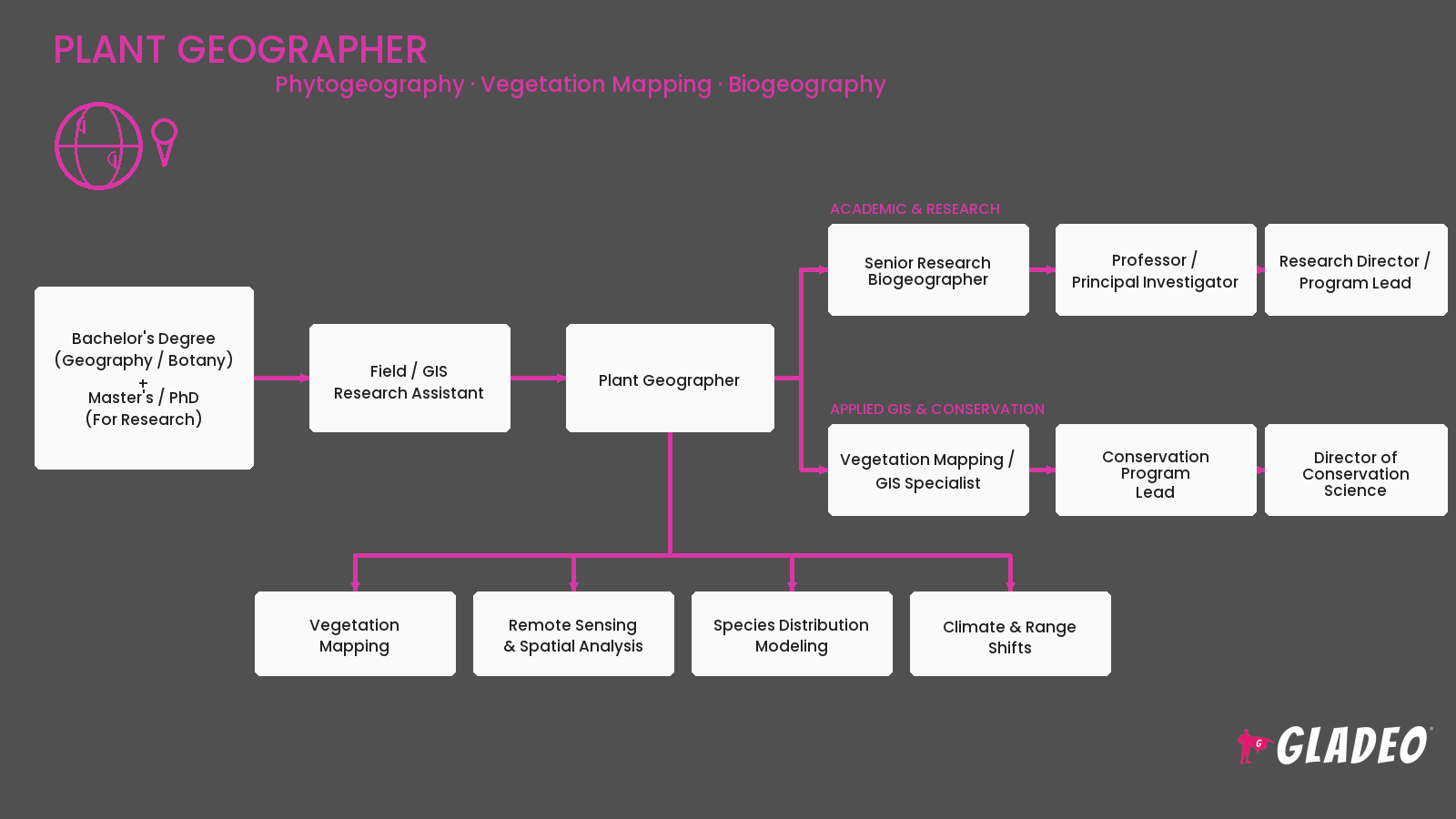
- Apply for internships or entry-level research assistant roles in environmental or botanical organizations.
- Build a portfolio of fieldwork and mapping projects.
- Volunteer in local conservation efforts to gain experience.
- Network with professors, researchers, and professionals in plant sciences.
- Attend conferences and workshops to learn and meet experts.
- Develop strong skills in GIS and data analysis software.
- Prepare a clear, focused resume highlighting relevant coursework and projects.
- Practice interviewing with a focus on scientific communication.
- Seek positions with government agencies, universities, or nonprofits.
- Be open to seasonal or contract work to build experience.
- Stay updated on current environmental issues and plant geography trends.
- Create an online presence showcasing your research or fieldwork achievements.
- Pursue advanced degrees (Master’s or PhD) to lead research projects and gain expertise.
- Publish research in scientific journals to build credibility.
- Develop leadership and project management skills.
- Build a professional network through conferences and collaborations.
- Seek specialized certifications in GIS or environmental modeling.
- Gain experience managing teams and budgets.
- Move into policy advising or consulting roles.
- Transition into academic or senior research positions.
Websites:
- Society for Conservation Biology (conbio.org)
- Botanical Society of America (botany.org)
- American Association of Geographers (aag.org)
- Ecological Society of America (esa.org)
- International Association for Landscape Ecology (iale.org)
- US Geological Survey (usgs.gov)
- National Geographic Society (nationalgeographic.org)
- Plant Conservation Alliance (plantconservation.org)
- Environmental Protection Agency (epa.gov)
- Global Biodiversity Information Facility (gbif.org)
- NASA Earth Science Division (earthdata.nasa.gov)
- NatureServe (natureserve.org)
- Agricultural Research Service (ars.usda.gov)
- International Union for Conservation of Nature (iucn.org)
Books:
- Plant Geography: Patterns and Processes by Walter H. Wagner Jr.
- Geographic Information Systems and Science by Paul A. Longley
- Ecology: From Individuals to Ecosystems by Michael Begon
- Conservation Biology: Foundations, Concepts, Applications by Fred Van Dyke
- Fundamentals of Biogeography by Mark V. Lomolino
If a career as a Plant Geographer doesn’t unfold as planned, many related careers also offer a chance to work with plants, environments, and geography in meaningful ways.
- Environmental Scientist
- Ecologist
- Botanist
- Forester
- Soil Scientist
- GIS Analyst
- Conservation Specialist
- Agronomist
- Wildlife Biologist
- Natural Resource Manager
Click here to download the infographic
Newsfeed

Featured Jobs
Online Courses and Tools